

If you’re a Googler sitting with the quiet sense that something in your work life no longer fits, you’re not wrong for feeling that way. You’re human. I’ve coached so many people who held this feeling privately for months or years, whispering inside: “Is it me? Or is something really shifting?” On the outside, everything looks enviable. But inside, there’s a subtle disconnect, hard to name, but impossible to ignore.
This guide isn’t here to push you toward leaving or staying. It’s here to help you hear yourself more clearly. Career transitions rarely start with a resignation letter. They begin with noticing the truth you’ve been carrying for a while.
Let’s walk through the reflections that help you understand where you truly are.
Your Energy And Well-Being
One of the clearest signs of misalignment shows up in your body. If your energy dips by Wednesday and only returns on weekends, that’s not “just a busy period.” That’s your system trying to keep up with sustained pressure.
Many tech workers report rising burnout symptoms, and research from places like McKinsey shows how workplace burnout is now deeply tied to ongoing systemic demands, not individual weakness. [1]
When your body consistently signals exhaustion, it’s usually asking you to reconsider the conditions you’re working in. And if this is hitting home for you, there’s value in talking it through early, before burnout takes root.
If this is hitting close to home, take note of the signs that it’s time for a career change.
Your Growth Trajectory
Growth doesn’t always mean promotions or a larger scope. It’s the feeling that you’re becoming a sharper, more expansive version of yourself. Many Googlers reach a plateau where they’re relied upon, well-liked, and operating smoothly, but not developing.
If your responsibilities feel like a variation of previous quarters, if learning has slowed, or if the thought of another year doing the same work feels heavy, you may have simply outgrown your role.
If this question keeps coming up for you, here’s a helpful breakdown to understand whether stepping into something new is truly right for you: Is It Worth Changing Careers?
Your Relationship To The Badge And The Other Reasons That Quietly Keep You There
People often talk about the badge as if it’s the main thing that keeps Googlers from moving on, but in truth, it’s rarely just the badge. It’s everything the badge represents. And along with that, there are other reasons you may still be staying, even if your current role no longer excites or energises you.
Some of it is practical. Google offers stability, strong compensation, and benefits that make life easier. When you’ve built your routines and responsibilities around that foundation, it’s natural to hesitate. There’s comfort in knowing your needs are met.
There’s also the ease that comes with the environment itself. The support, the resources, the people. It’s a world that can make work feel smoother, even when you’re not feeling inspired. Walking away from that kind of structure can feel daunting.
And of course, there’s the identity piece. Being part of a company so widely respected becomes woven into how you see yourself. It’s something you’ve worked hard for. Letting go of that can feel bigger than a career decision; it can feel like an emotional shift as well.
So if you’re noticing that you’re staying more for the stability, the familiarity, or the sense of identity than for the work itself, that’s not something to judge. It’s something to acknowledge. And if that acknowledgment brings up a quiet sense that something needs to shift, that’s usually a sign that you’re ready to explore what comes next.
If you’re starting to sense that you’re staying for reasons that no longer feel true to you, let’s explore that together.
Your Values Fit
Values shift over time, for you and for the organization. It could be that the environment was once creative and curious, but now feels more operational or efficiency-driven. Maybe leadership priorities have changed, or maybe you have.
Values misalignment doesn’t always show up as conflict. Sometimes it shows up as numbness. A sense of quietly withdrawing. Losing the spark. [2]
Your Imagination
People rarely talk about this, but your imagination is one of your best career indicators. If your mind drifts toward different roles, environments, or ways of working, smaller companies, mission-led teams, creative paths, or user-facing work, that’s not escapism. It’s your future tugging at your sleeve.
Most people come to coaching and eventually say something like, “I keep imagining something different, and I’m tired of ignoring it.”
That whisper is information. It is a direction.
Your Fear Levels
Fear is often the loudest voice in the head. Fear of losing compensation. Fear of disappointing family. Fear of leaving a known brand. Fear of being less successful elsewhere. Fear of making the wrong move.
But fear is not the same as wisdom. A powerful question to sit with is: “If fear weren’t in the room for a moment, what would I choose?”
That instant answer is usually your truth.
If fear has been leading the conversation, here’s a guide on navigating career change when you’re worried about a pay cut: What If I Want to Change Careers But Can’t Afford a Pay Cut?
Your Alternatives Inside Google
Before making any decisions, it’s wise to check whether something inside Google still calls you. A different team, a new product, a shift in role, a new manager. Sometimes a small move inside the company can bring fresh energy. But if you’ve explored internal paths and still feel flat, that’s valuable clarity too.
Exploring beyond Google doesn’t mean you’re turning your back on anything. It’s simply acknowledging what’s true for you now.
If you want guidance on navigating internal conversations, these may help:
How to Talk To Your Manager About Career Growth: Best Way To Increase Your Odds In The Conversation
Your Skills Inventory
Many Googlers worry their skills won’t translate. But the opposite is true. Your ability to work through ambiguity, collaborate across functions, solve complex problems, lead through change, communicate with clarity, design systems, build trust, and handle complexity is deeply valuable anywhere.
The real work is learning how to describe your experience in a way that makes sense outside Google. You’re not starting over. You’re starting from experience, strength, and depth.
If you’d like help repositioning your strengths, this guide may support you:
Mid-Career Resume 101: How to Update Your Resume With Current Job or Future Job
Your Readiness For Experiments
Transition rarely begins with a dramatic leap. It begins with tiny, low-pressure experiments. Advising a startup. Trying small consulting projects. Shadowing someone in a role you’re curious about. Exploring ideas you haven’t touched in years.
These small experiments give you data, energy, and direction, and help you discover what feels alive. If you find yourself intrigued rather than terrified by the idea of testing something new, you’re probably closer to ready than you think.
You can also explore new paths while staying internal. This might help you think more creatively: Intrapreneurship: How to Grow Your Career Without Changing Jobs
Your Support System
Friends and family mean well, but because they care so deeply, their perspective can sometimes mirror their own fears more than your truth. Having a safe, confidential space to explore your truth without noise can make all the difference.
Many Googlers find clarity quickly once they’re speaking with someone who understands both the internal world of big tech and the emotional reality of stepping beyond it.
If you want support from someone who understands Google from the inside and the outside, Claire can help you explore your next chapter.
Practical Steps To Explore A New Career Without Burning Everything Down
Admitting you might want a career change is a big moment. The next challenge is figuring out what to do with that truth without blowing up your stability. Most people can’t just walk away overnight. You have bills, responsibilities, and people depending on you. This part is about moving gently, not dramatically.
Step 1: Specify: Name What You Are Moving Toward, Not Just What You Are Leaving
It’s easy to say, “I think I want to leave Google” when you’re frustrated. What’s harder, and more honest, is asking, “What kind of work life do I want next?”
You don’t need a perfect job title. Start with the basics: the kind of environment you want, the level of autonomy you need, the pace that suits you, and whether you want to stay in big tech or try something smaller or more mission-led. Even a rough direction is enough. Something like, “I want to use my skills closer to the user, in a smaller company where my decisions actually shape the product,” is a great start.
Step 2: Map the Value of What You Have Already Built
A lot of ex-Googlers quietly fear their skills are too niche. They’re not. Most companies aren’t hiring for titles, they’re hiring for capability. And the truth is, the kind of experience you’ve gained at Google translates incredibly well.
If you’ve worked across functions, built at scale, solved complex problems, mentored others, or advocated for the user, you already have the foundation that many industries are hungry for. Your next step isn’t to reinvent yourself. It’s to learn how to talk about what you’ve done in a way that people outside Google can recognize. That’s it.
Step 3: Use Micro Experiments Instead of One Big Leap
We often think career change means “all or nothing.” Stay or resign. Safe or risky. That kind of thinking keeps people stuck for years.
A gentler, more realistic approach is to run small experiments. Test a few things. Help a friend with a project. Consult a little. Volunteer skills you’re curious to use. Teach. Shadow someone doing a role that interests you.
These small tests give you real data: how the work feels, how your energy responds, and whether the direction excites you. And if you’re still at Google, you might be able to shift your current role slightly, take on a stretch project, shadow a team, or explore internal moves. Sometimes internal movement is a bridge to external clarity.
Step 4: Talk To People Who Have Already Moved
There’s nothing more grounding than hearing real stories from people who left big tech and landed well. You’re not asking for a job, you’re learning why they moved, what surprised them, and what they wish they’d known.
These conversations often reveal paths you wouldn’t have spotted on your own. [3,4]
And you’ll quickly see that many ex-Googlers found more energy, purpose, or balance once they stepped into environments that fit them better.
Step 5: Get Support So You Are Not Doing This Alone
There is a reason career coaching has expanded as a field. Many mid career professionals find that having a neutral, trained thought partner helps them see patterns, challenge unhelpful beliefs, and move into action more quickly. Studies and practitioner reports consistently describe benefits such as clearer goals, better decision-making, and higher satisfaction when people work with a coach during transitions. [5,6]
A coach will not choose for you, and they will not magically fix conditions inside your company. What they can do is help you reclaim your own agency, sort your options, and design experiments that fit your real-life constraints. That is especially valuable if you tend to overthink or if you have been stuck in research mode for months.
If you need guidance from someone who understands big tech transitions, Claire offers a free 30-minute session.
Define Your Ideal Role & Industry
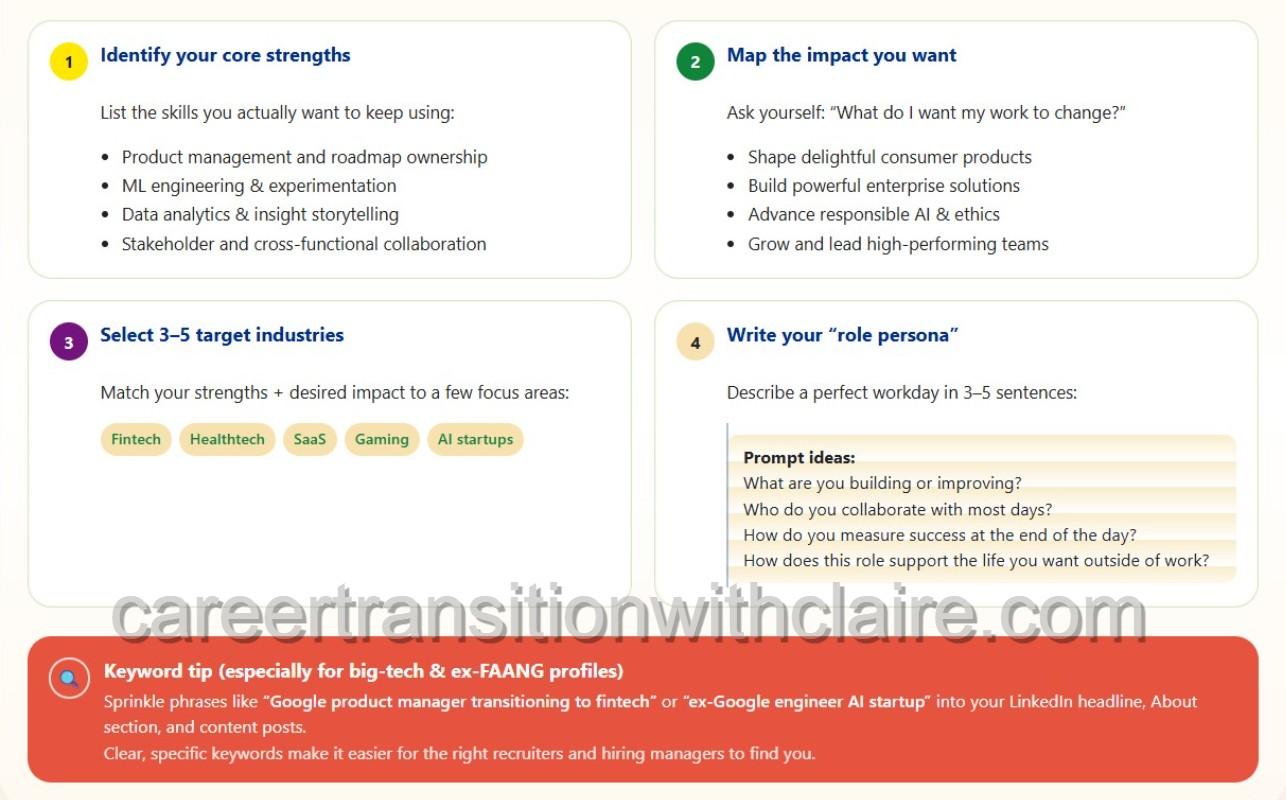
Many people start their job search by looking at postings, but the most successful transitions begin with clarity. When you take time to define your ideal role, your strengths, the impact that feels meaningful, and the environments where you do your best work, everything else becomes easier.
You communicate your value more confidently.
You attract roles that genuinely fit your life.
And you stop wasting energy applying to jobs that were never aligned in the first place.
This simple four-step framework is your guide to every decision you make in your transition.
Evaluate Compensation & Benefits
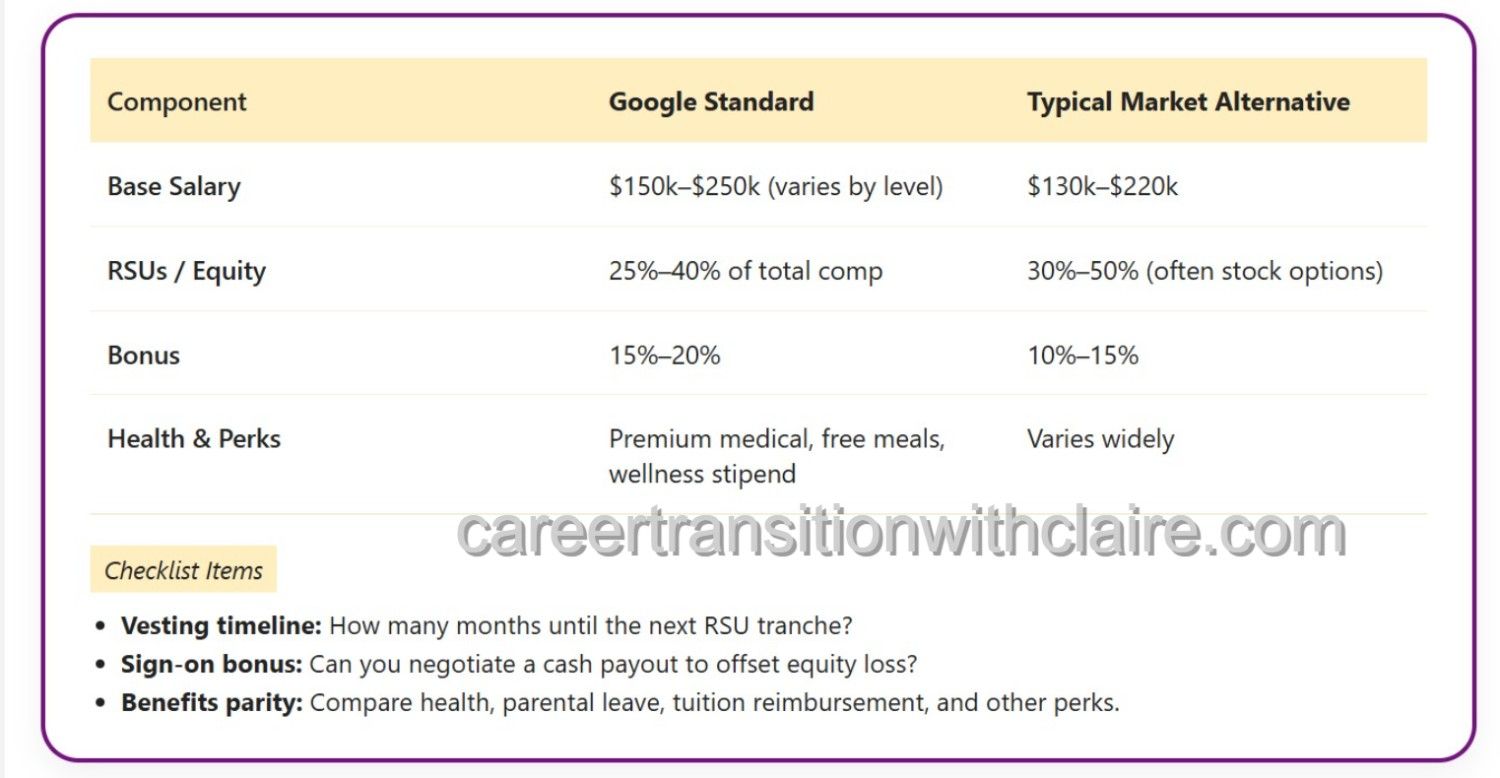
Compensation packages can look very different outside of big tech, which is why comparing each component side-by-side is so important. Instead of focusing on base salary alone, consider the full picture, equity structure, annual bonus, health benefits, and any perks that meaningfully affect your quality of life.
This helps you understand where an offer is strong, where it may fall short, and what’s worth negotiating. Looking at each element in context allows you to make clearer, more confident decisions about whether a role truly supports both your financial goals and lifestyle needs.
Cultural Fit & Work‑Life Balance
Cultural fit plays a major role in long-term satisfaction, especially when transitioning out of a highly structured environment like Google. Taking time to understand how a company makes decisions, communicates, and supports work-life balance helps you predict whether you’ll feel energized or drained in the day-to-day. The goal isn’t to find a “perfect” culture, but one that aligns with how you work best.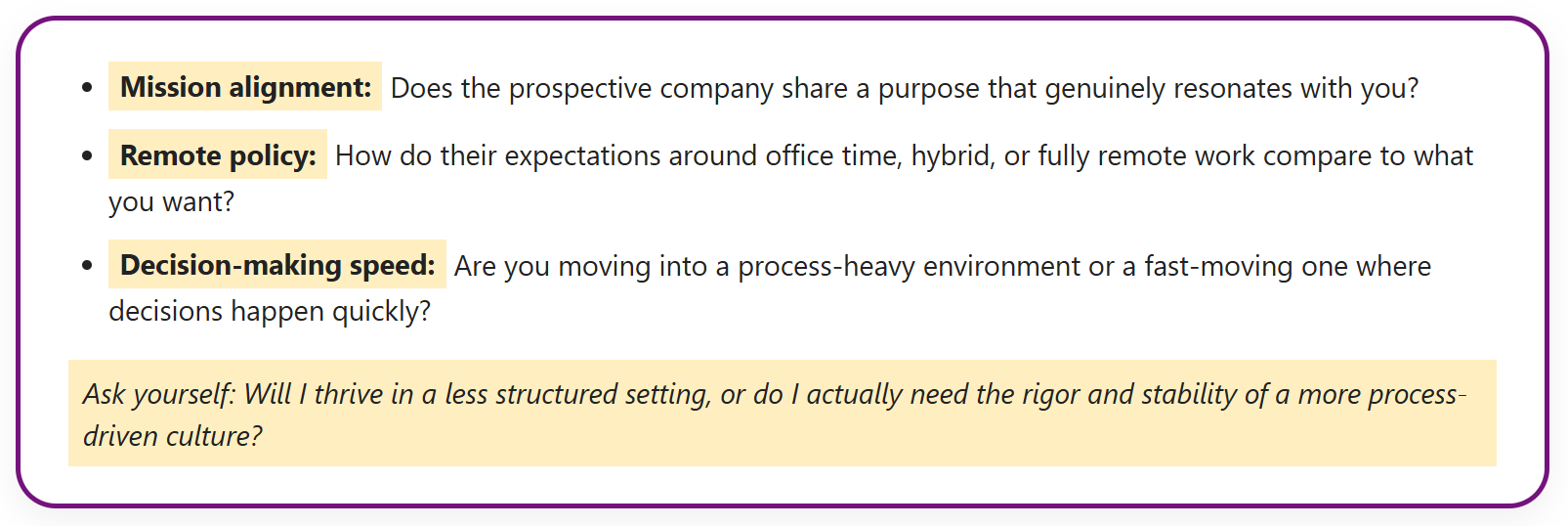
Growth & Learning Opportunities
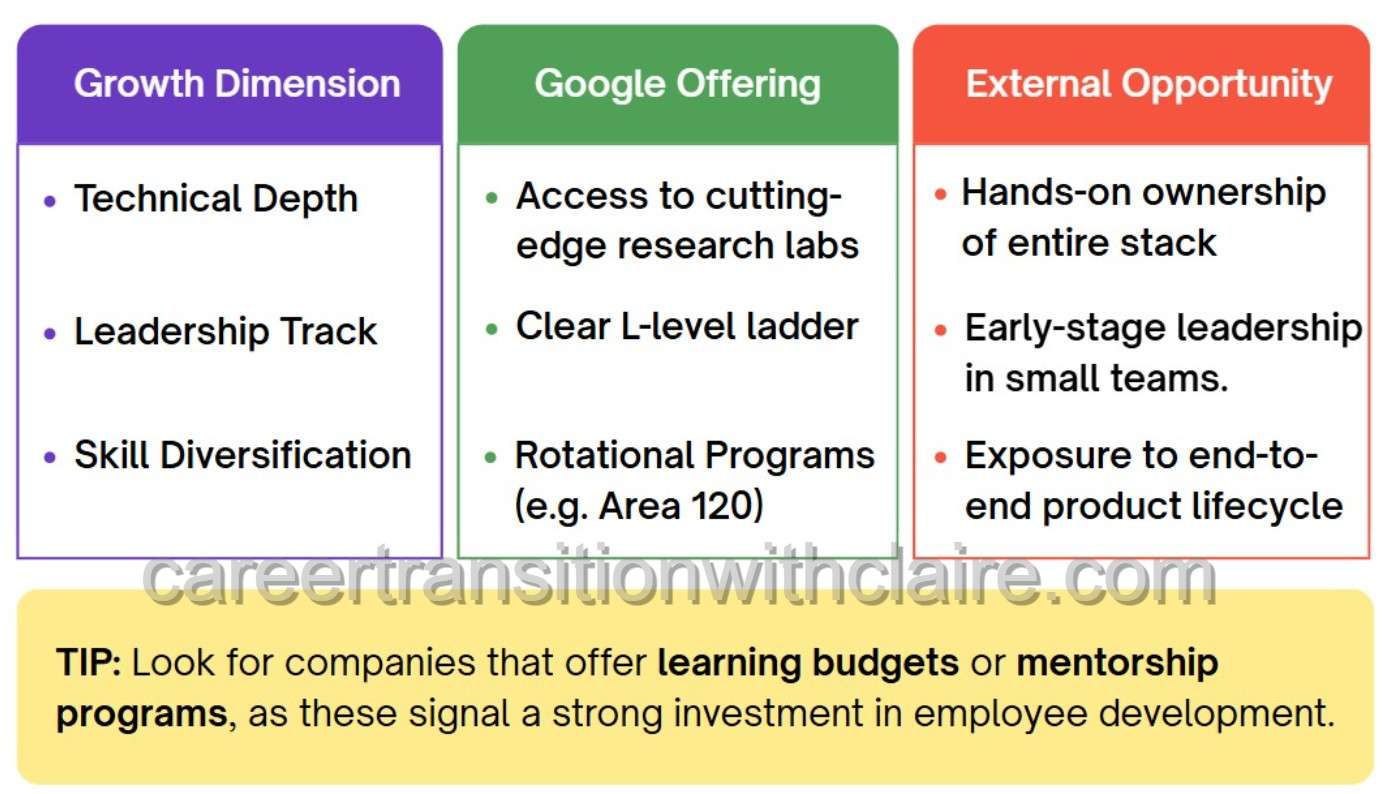
When you’re evaluating growth potential, it’s helpful to compare what you’re gaining at Google with what you might gain elsewhere. Big tech environments often provide structured paths, world-class resources, and access to specialized teams, but they can also limit how much ownership or breadth you get day-to-day.
Smaller companies or startups, on the other hand, may offer faster leadership opportunities, broader skill development, and exposure to the full product lifecycle. Understanding these trade-offs helps you choose the path that best supports the kind of career and the kind of growth you want next.
How To Interpret Your Answers
If several of these checkpoints create a sense of recognition, or even relief, it’s usually a sign that you’re not in a passing dip, but standing at the edge of a real turning point.
This checklist is only the starting point. The deeper work happens when you investigate what you want more of, what constraints matter, and what kind of environment would allow you to thrive in your next chapter.
If you want help exploring this with someone who understands both the internal world of Google and the emotional realities of leaving, Claire offers a free 30-minute clarity session where you can talk through your situation, understand your options, and begin outlining a path that fits who you are now.