

If you’re a Product Manager who no longer wants to manage stakeholders, you’re not overreacting. This is one of the most common challenges I hear, especially from women in tech who are starting to question whether the way they’re working still feels right for them.
Stakeholder management may have once felt energizing, a chance to collaborate, influence, and shape outcomes, but now it’s heavy, draining, and endlessly political. It is no longer a task on your calendar. It has become the part of the job that asks the most from you, often without giving anything back.
Product managers experience high stress from cross-functional coordination and unclear decision-making structures, noting that misaligned stakeholders and constant context switching are key drivers of burnout. [1]
Many PMs report that a substantial amount of their time goes toward alignment rather than deep product work. As one product manager notes in a 2021 Medium article, “I interact with 50–60 people a month, and spend around 25% of my time in meetings.” [2] While this is a single data point, it echoes a common pattern: product roles often require extensive cross-functional communication that crowds out strategy and user-focused thinking.
So if your energy is collapsing under the weight of stakeholder work, that is not a personal shortcoming. It is a signal. And signals deserve to be listened to.
If you’re a PM questioning whether this version of product work is still right for you, Claire can help you sort through your options with clarity.
Why Stakeholder Management Has Become the Breaking Point for So Many PMs
When women tell me they no longer want to manage stakeholders, the frustration is rarely about a single meeting or a difficult executive. It is the buildup of emotional labor caused by trying to get people with conflicting priorities to move in the same direction.
The Product Manager role places you at the center of every dependency and every decision. You become the translator for the engineering team, the storyteller for the sales team, the coordinator for the design team, the negotiator with leadership, and the one who silently absorbs the conflict when different stakeholders cannot agree.
Research continues to show that cognitively demanding roles carry hidden psychological strain. In a 2024 study published in the Journal of Behavioral Decision Making, “Prolonged and high-intensity cognitive activities are prone to inducing mental fatigue (MF), which adversely affects both psychological and physiological well-being, as well as task performance.” [3]
Similarly, a 2023 report on emotional labor found that “the silent, invisible strain of emotional labor can take a significant, long-term toll on mental health, frequently leading to burnout, decreased job satisfaction, and a host of other debilitating issues.” [4]
It’s not about your capability to do the role. You are more than capable and have proven it. It’s about sustainability. And the truth is that the PM role has expanded faster than companies have adapted to it.
Product responsibilities have ballooned across industries, often without proper structure or clarity. PMs are left overloaded and unsupported, carrying stakeholder relationships without the authority or resources to make a decision that satisfies everyone. [5]
The work has grown. The support has not.
How Product Managers Get Stuck in Endless Stakeholder Management Cycles
Many Product Managers describe stakeholder management as the part of product work that never ends. The moment one stakeholder request is addressed, another appears. The product roadmap becomes a battleground of different priorities. One stakeholder escalates to the executive team. Another insists their customer feature requests must go to the top of the product backlog. The sales team wants new features to unblock a deal. The engineering team pushes back on unrealistic delivery timelines. The development team raises constraints and dependencies. And the Product Manager stands in the middle of it all, trying to align people who never agreed on the desired outcomes in the first place.
Stakeholders may bring objections or concerns that require immediate attention. A particular stakeholder might have veto power over key decisions. The CEO may want a new product initiative moved up the roadmap. Meanwhile, customers also have expectations that must be validated. Many stakeholders believe their request is the most urgent one. This puts PMs in a position where they must prioritize tradeoffs with very little room for error.
In environments like this, stakeholder management becomes less about building a successful product and more about managing expectations and avoiding conflict. It is no wonder many product managers reach a breaking point.
Burnout and identity shifts often rise together. High emotional demands combined with low autonomy are strongly linked to burnout and eventual withdrawal from a job. [7]
If you’re ready to explore roles that fit your strengths without the constant stakeholder load, Claire can guide you through that transition.
If Stakeholder Management Is Not Working for You, What Happens Next
This is where strategy and self-awareness meet. When a PM reaches this point, the real work is understanding what the resistance is trying to reveal. Is it the role? The environment. The leadership. Or is it your evolving values?
Common directions include Product Operations, UX Research, Program Management, Product Strategy, Customer Experience, Business Operations, and sometimes careers outside of tech, where their leadership and systems thinking offer enormous value.
Others have done it, and you can do it too.
How to Know Whether to Change Roles or Change Careers
This is one of the hardest questions to navigate. Misalignment between job expectations and personal capacity is one of the strongest indicators of disengagement and turnover intention.
When a job asks for more emotional labor than your values or energy can sustain, something has to shift. The work becomes too heavy.
Sometimes the solution is a new PM role with clearer structures. Sometimes it is a new function entirely. And sometimes it is the beginning of a more meaningful career transformation.
What Career Paths Can You Move Into If You Want to Avoid Stakeholder Management?
Below are the strongest-fit paths for PMs who want less political navigation and more flow, ownership, and autonomy. These are highly compatible with your background and offer a softer landing while still honoring your product experience.
1. UX Research or Product Discovery Specialist
If your favorite part of PM work has always been customer insights, problem framing, or discovery, roles in UX research or discovery operations offer depth without the stakeholder chaos. These roles are more craft-focused and often involve more independent work.
2. Product Strategy or Corporate Strategy
This path leans heavily on analytical thinking, competitive analysis, and market strategy, often with fewer team coordination demands. Strategy teams typically have clearer boundaries, fewer ad-hoc requests, and more project-based work.
3. Product Operations (ProdOps)
Product Ops is increasingly popular in 2025. It still leverages your product knowledge but focuses on systems, workflows, tooling, and operational efficiency, not daily stakeholder management. PMs often find this path more structured and less emotionally taxing.
5. Data Product Roles or Analytics Roles
If you love making decisions based on data, analytics roles allow you to go deep, build meaningful insights, and stay closer to problem-solving without constant meetings.
6. Content Design, Technical Writing, or Knowledge Architecture
PMs with strong communication skills often thrive in content design or tech writing, roles that allow for deep work, craft, and clear deliverables instead of alignment-building.
7. Product Coaching, or Consulting
Many mid-career PMs choose to pivot into coaching or consulting, leveraging their experience without the draining parts of corporate life.
What Ex-PMs Tend to Move Into (According to Reddit Insights)
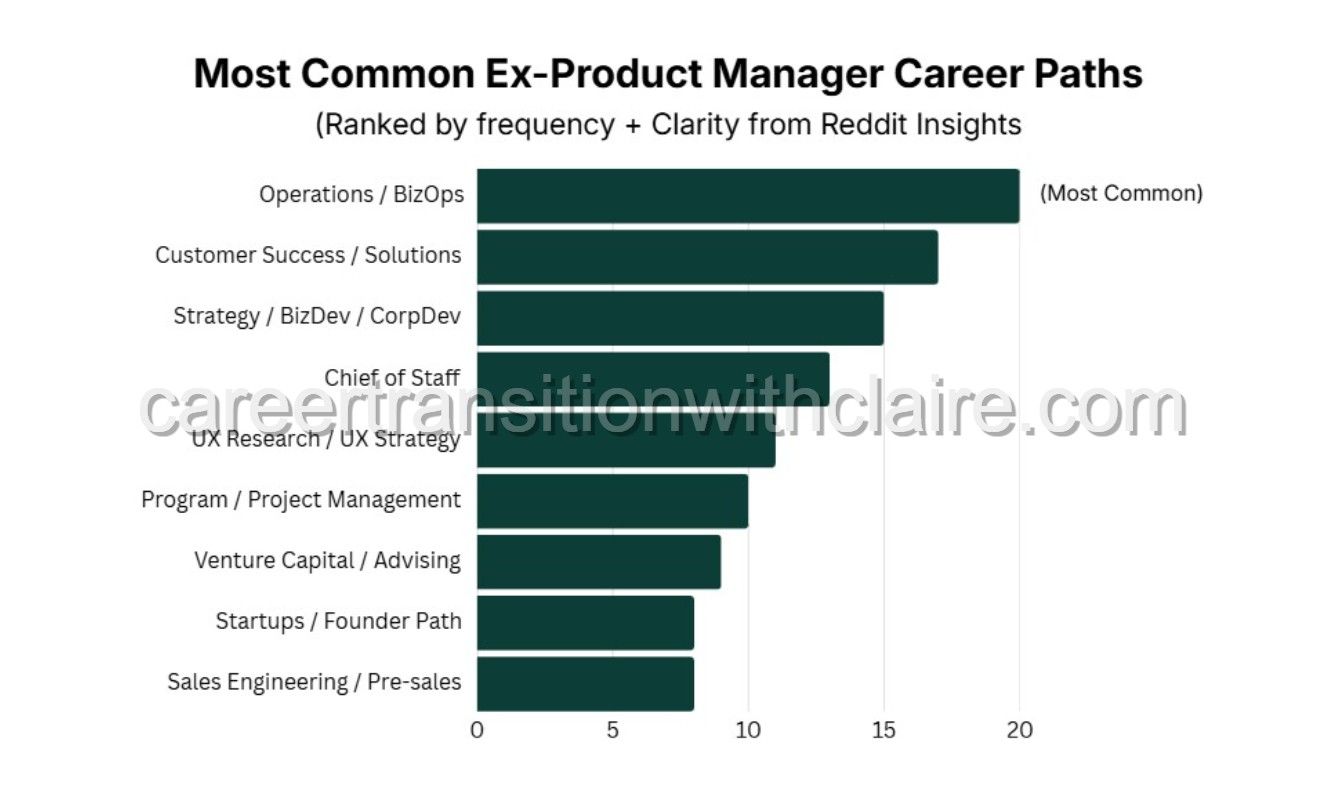
According to discussions on Reddit, many former Product Managers transition into a wide variety of roles after leaving PM. Several paths were mentioned repeatedly:
“Customer Success, Biz Dev (strategy), Chief of Staff to a COO, Operations Manager, maybe pre-sales or sales engineering.”
“VC is another great avenue for ex-PMs – transferable skills and experience.”
“Some of us became UX Research (UXR) full-time.”
Across these conversations, a few clear career patterns emerge. Former PMs often move into:
Business, Strategy, BizDev, Corporate Development, or Operations roles: areas that rely on a PM’s ability to think strategically and manage complex systems.
Customer Success, client-facing roles, pre-sales, or sales engineering: often appealing to PMs who enjoy communication and want more external-facing work with clearer outcomes.
Consulting, advisory, or startup/VC-related work: leveraging product intuition to evaluate opportunities, advise founders, or contribute at the early stage.
User Experience Research or UX-adjacent roles: especially for those who miss hands-on discovery, creativity, and working closely with users.
Startups, smaller companies, or founder-adjacent roles: PM is seen as “generalist training,” making it a strong fit for broader ownership in early environments.
Why PMs Transition: Key Motivations and Frustrations
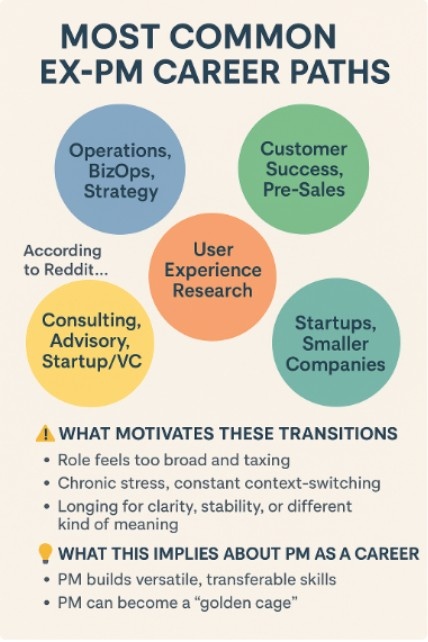
Redditors consistently describe similar reasons for leaving product management:
The role becomes overwhelmingly broad and taxing.
As one commenter put it:
“I never knew I had to be the marketing manager, sales lead, product owner, hiring strategist, and corp-dev analyst … all in one.”
Chronic stress is rooted in constant context switching and unclear priorities. Many mention “crunchtime,” shifting roadmaps, long hours, and unpredictable organizational changes as burnout triggers.
A desire for clarity, stability, or a different kind of meaning. Some want to “make instead of manage,” or pursue work that aligns better with their energy and life stage.
Dissatisfaction with PM scope or direction. Several note that the role can drift into politics, pressure, or stakeholder management rather than meaningful product impact.
The takeaway across these threads is clear: Ex-PMs don’t leave because they “can’t handle it.” They leave because the role no longer fits their values, energy, or well-being.
What This Suggests About PM as a Career (And Career Change in General)
PM skills are deeply transferable. Product management builds strategic thinking, communication, cross-functional collaboration, and problem-solving skills that translate across industries. This aligns with broader observations from sources like Wikipedia and Product School, which note that PM skills map well beyond traditional product roles.
PM can become a “golden cage.” The salary, prestige, and visibility can keep people in roles long past the point of alignment. Ego, comfort, and fear often play a bigger role than interest or growth.
Most PM career changes begin quietly and internally. People rarely quit abruptly. Instead, they slowly recognize that the role no longer aligns with their values, energy, or desired work-life rhythm. PM becomes a foundation, not a final destination.
What Someone Considering Leaving PM Should Take Away
If you feel drained or misaligned, it’s not a personal failing. The PM often demands strategy, delivery, influence, communication, technical fluency, and emotional regulation, all at once. Feeling stretched is normal.
Your PM experience opens doors, not closes them. You can pivot into operations, biz-dev, UX research, consulting, or entirely different industries while still leveraging your strengths.
A career change doesn’t discard your previous work. It repurposes it. Many ex-PMs report more clarity, less stress, and greater purpose after shifting into roles that match their values and stage of life.
Your PM background is an asset in any transition. Frame your experience in terms of business value, outcomes, influence, and problem-solving, not just product terminology.
Career Paths That Reduce Stakeholder Load
1. Product Operations (ProdOps)
Why it fits: Focuses on building and maintaining the processes, tooling, and data pipelines that keep product teams running smoothly.
Typical duties: Metrics dashboards, rollout automation, intake‑form design, cross‑team workflow optimization.
Stakeholder load: Mainly internal. You serve the product org rather than constantly negotiating with multiple external groups.
2. Data‑Product / Analytics Specialist
Why it fits: Your work centers on extracting insights, building dashboards, and creating data‑driven products.
Typical duties: SQL/warehouse modeling, self‑service BI, A/B‑test analysis, data‑product roadmap (mostly technical).
Stakeholder load: Interaction is mostly limited to requesting data or presenting findings; you rarely have to mediate competing priorities.
3. Technical Writer / Content Designer
Why it fits: You translate complex product information into clear documentation, tutorials, or help‑center articles.
Typical duties: Writing API docs, user guides, release notes, UI copy, and knowledge‑based structuring.
Stakeholder load: Collaboration is usually with subject‑matter experts (engineers, PMs) on a consultative basis rather than ongoing alignment negotiations.
4. Career/Product Coaching / Consulting (Independent)
Why it fits: You act as an advisor to individuals or small teams, drawing on your PM experience without being embedded in a larger org’s politics.
Typical duties: One‑on‑one coaching sessions, workshop facilitation, portfolio reviews, and freelance consulting projects.
Stakeholder load: Clients are the primary “stakeholders,” and the relationship is clearly defined and contract‑based, eliminating internal corporate politics.
5. Research‑Focused UX / Market Research (Specialist)
Why it fits (when scoped correctly): If you stay within a pure research function, designing studies, analyzing user data, and delivering reports, you can avoid the iterative alignment loops that product managers face.
Typical duties: User interviews, surveys, usability testing, synthesis of findings, publishing research briefs.
Stakeholder load: Limited to presenting findings to product teams; you’re not responsible for getting those findings implemented.
What these roles have in common is that they let you stay close to product development without carrying the full weight of product ownership. They tap into the strengths many ex-PMs naturally have: systems thinking, analytical rigor, structured communication, user empathy, and coaching-oriented leadership, but do so in a way that’s far more sustainable.
If you’ve been feeling stretched thin by constant alignment cycles, shifting priorities, and decision pressure, exploring one of these adjacent paths can open the door to work that feels calmer, clearer, and more aligned with how you actually like to contribute. The key is identifying which responsibilities you naturally gravitate toward and choosing a role that lets those strengths shine.
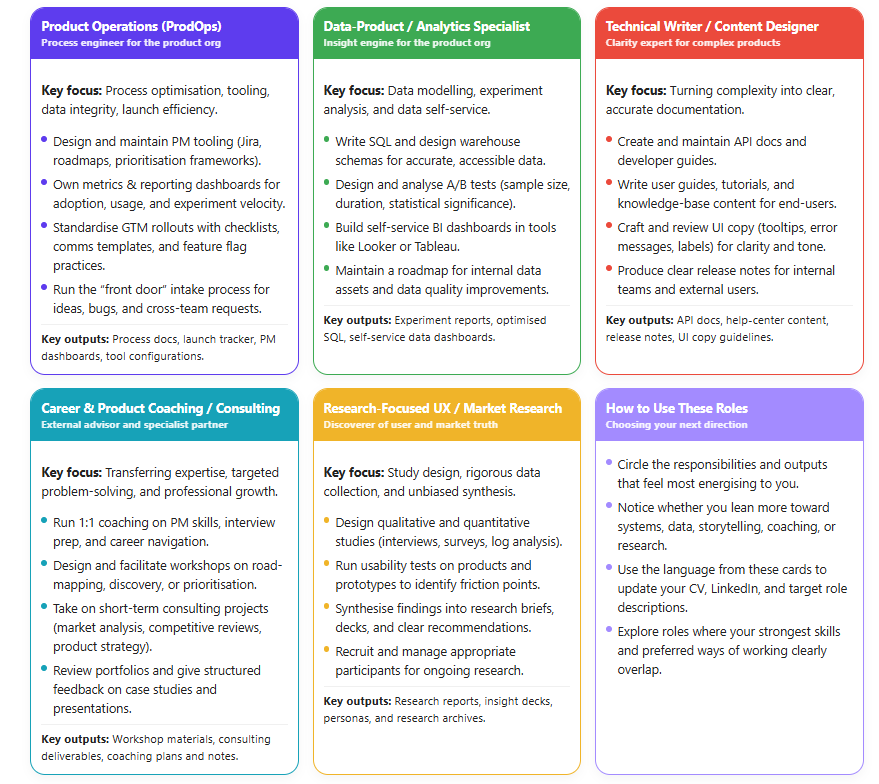
Detailed Responsibilities and Key Outputs
Not every product career needs to follow the traditional PM track. These five specialties show how diverse and meaningful the work around product can be, from operational excellence to data-driven insight, to storytelling, coaching, and deep user research.
As you explore your next chapter, notice which responsibilities feel exciting and which outputs come naturally to you. That’s often the strongest signal of where you’re most likely to thrive.
How to Decide Whether You Should Leave Product Management in 2025
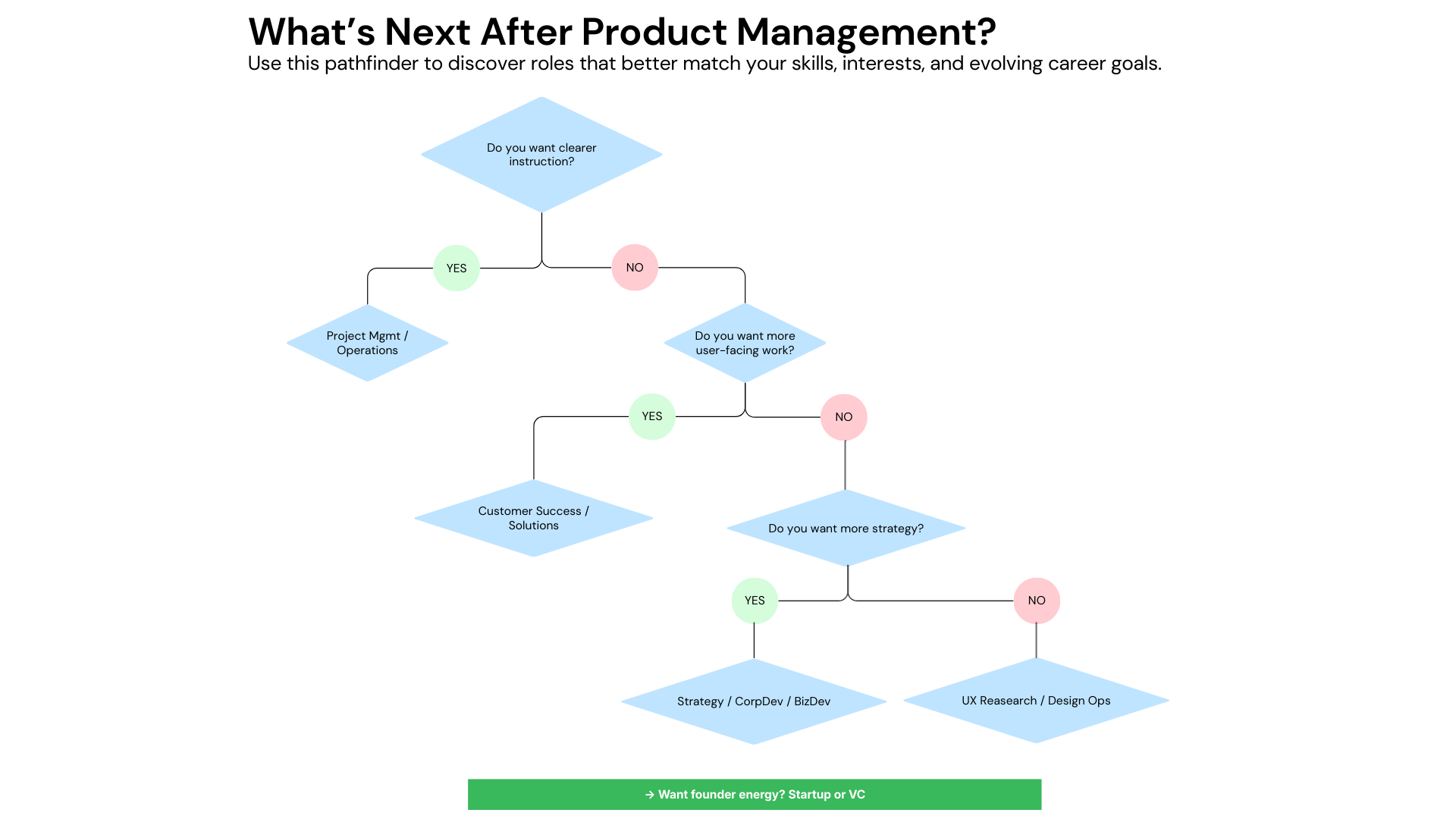
The decision comes down to three questions:
1. Are you tired of product, or tired of this version of the product work?
Some PMs love product but hate the environment they’re in. If your company is chaotic, misaligned, understaffed, or lacking product maturity, you may simply be doing the job without the necessary support.
2. Do you want more autonomy or more stability?
Some adjacent roles give more clarity and structure; others give more creative or strategic freedom. Understanding which matters more to you helps clarify your path.
3. Can you imagine yourself in a senior PM role?
If the honest answer is “No,” that’s usually the clearest indicator that a pivot is the right move.
How to Transition Out of Product Management Without Losing Your Identity or Pay
Many PMs worry that transitioning out of the product will mean losing compensation, status, or influence. But with the right strategy, you can maintain or even increase your earning potential, especially when moving into strategy, solutions architecture, or high-impact IC roles.
A strong transition plan starts with identifying which parts of the product work you want to carry forward and which you’re ready to leave behind. From there, map your existing skills to roles that are a better fit and have fewer stakeholder pressures, then rewrite your resume to emphasize strengths rather than task lists. Build a clear narrative that frames your pivot as intentional and value-driven, and practice demonstrating your transferable skills in interviews so hiring managers can easily see how you’ll excel in a new context.
If you’re done carrying the weight of alignment work alone and want a grounded plan for what comes next, Claire can help you map your path forward.
FAQ: Product Manager Career Change (Designed for Featured Snippets)
Is it normal for Product Managers to dislike stakeholder management?
Yes. Research on workplace collaboration overload shows that excessive meetings and cross-functional alignment contribute significantly to burnout. PMs are particularly exposed to this dynamic.
Can I leave product management without taking a pay cut?
Absolutely. Roles in strategy, solutions architecture, product operations, and analytics often pay similarly or even more than PM roles, especially in large tech companies.
Which roles require the least stakeholder management?
UX research, data roles, content design, product operations, and technical writing typically involve substantially fewer cross-team negotiations.
Will leaving PM hurt my long-term career prospects?
Not when done intentionally. Product experience is highly transferable and signals strategic competence, making you strong for many leadership or IC specialty tracks.
You Do Not Have to Carry This Question by Yourself
If you’re a Product Manager who dreads managing stakeholders, stop seeing it as a failure. Think of it as a pivot. The resistance you feel is just information. It’s signaling you to find a better aligned path.
This is where clarity matters. This is where support matters. Coaching creates space to think clearly, reconnect with your strengths, and explore what this moment is trying to tell you.
You do not need to rush or blow up your career to find your next step. You need the right framework and someone who can help you navigate the messy middle without losing yourself in the process.
I help women untangle these questions, rebuild confidence, and design a career path that fits who they are now. If something in you is shifting, let us honor that and see where it leads.
Book a Discovery Call with me and let us figure out your next chapter together.
References:
- https://www.mindtheproduct.com/burnout-in-product-managers-a-world-mental-health-day-report/
- https://medium.com/getting-started-in-product/what-meetings-are-product-managers-spending-their-time-in-14a581efa230
- https://pubmed.ncbi.nlm.nih.gov/40563713/
- https://www.talktoangel.com/blog/silent-strain-of-emotional-labor-in-service-jobs
- https://adaptmethodology.com/blog/from-project-to-product-the-mandatory-paradigm-shift/
- https://www.reddit.com/r/ProductManagement/comments/i5plml/what_roles_do_exproduct_managers_usually_go_for/