

You survived the reorg. The dust is settling, the new org chart is out, and everyone is pretending things are fine. But you are not fine. You are exhausted, disoriented, and quietly wondering whether this company still has a place for you, or whether you still want a place in it.
If that sounds familiar, you are not alone. Corporate reorganizations are among the most psychologically disruptive events a professional can face, and the aftermath is often harder than the event itself. A systematic review published in Work & Stress found that restructuring events have a predominantly negative impact on employee well-being, with effects persisting well beyond the initial announcement. If you have already read our guide on how to prepare psychologically when your company is restructuring, this article picks up where that one left off. This is about what comes next: processing what happened, rebuilding your confidence, and finding genuine clarity about where your career goes from here.
If the reorg left you questioning everything about your career, you do not have to figure it out alone.
Why a Reorg Hits Harder Than Most People Expect
A reorganization reshapes your daily reality. Your manager might be different. Your team might be scattered. The project you spent a year building might be deprioritized overnight. And nobody handed you a playbook for what to do with all of that.
Research from Frontiers in Psychology shows that organizational changes negatively affect the psychosocial work environment, including factors like job control, predictability, and social support, all of which are directly tied to mental health. A study published in BMC Public Health confirmed that organizational change increases risks for anxiety, depressive symptoms, and burnout among affected employees.
What makes a reorg uniquely difficult is the ambiguity. Unlike a layoff, where the loss is clear, a reorg leaves you in a gray zone. You still have a job, so people expect you to carry on. But the role you accepted, the team you chose, and the trajectory you were building may no longer exist. That gap between what was promised and what now exists is what psychologists call a psychological contract violation, and it is one of the most significant predictors of disengagement and distress after restructuring.
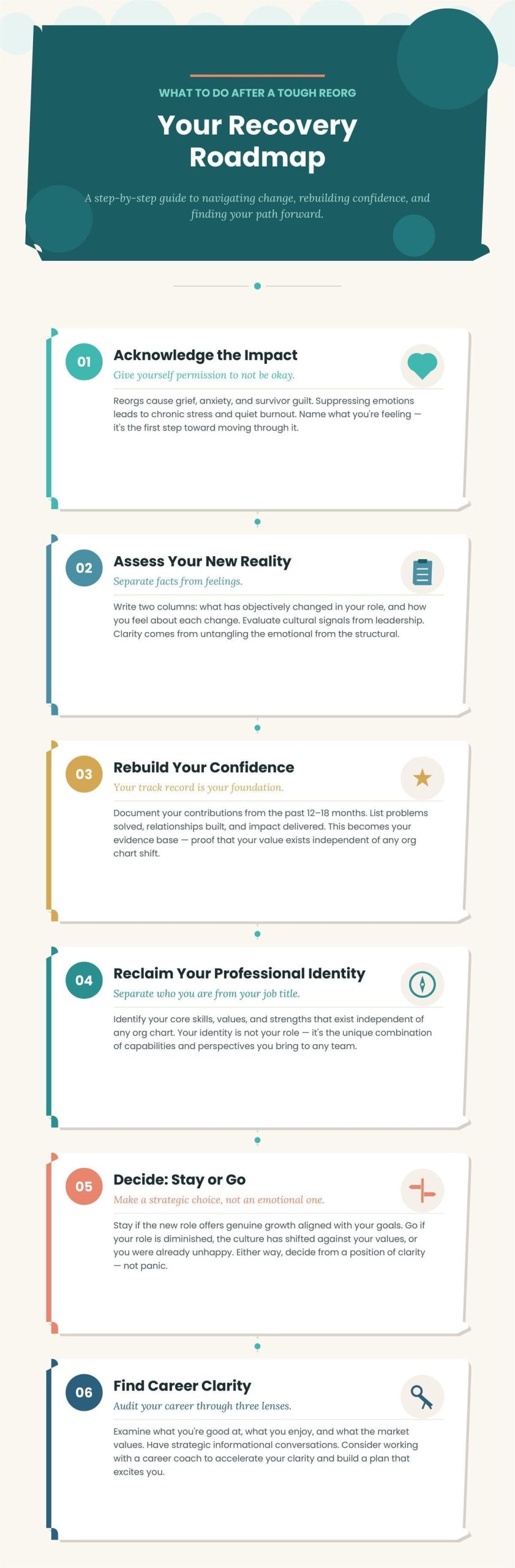
The First Thing to Do: Give Yourself Permission to Not Be Okay
The instinct after a reorg is to push through. High performers especially tend to double down, prove their value, and suppress whatever they are feeling. But research consistently shows that acknowledging negative emotions actually improves your ability to stay optimistic and perform well over time.
This does not mean spiraling. It means naming what you are experiencing. Are you grieving a team that got broken up? Are you angry about a decision that felt arbitrary? Are you scared about what comes next? These are normal, healthy responses to a genuinely disruptive event. Suppressing them does not make them disappear. It just turns them into chronic stress, which is exactly what fuels the “quiet burnout” trend that researchers have been flagging in 2026, where professionals maintain performance on the outside while deteriorating on the inside.
Give yourself a defined period to sit with the discomfort. Journal about it. Talk to a trusted friend or mentor. Process the experience before you start making career decisions from a reactive place.
How to Assess Your New Reality with Clear Eyes
Once you have given yourself some breathing room, the next step is an honest assessment of where things actually stand. Not where you wish they stood, and not the worst-case scenario your anxiety is constructing, but the objective reality of your current position.
Ask Yourself These Questions
Start by getting specific about what has changed. Who is your new manager, and what is their leadership style? Has your scope expanded, contracted, or shifted sideways? Are the projects you care about still funded and supported? Do you still have a path to the outcomes that matter to you, whether that is promotion, skill development, or meaningful work?
Then evaluate the cultural signals. Is leadership being transparent about the reasons behind the reorg, or are you getting vague corporate talking points? Are the people you respect sticking around, or are you watching a quiet exodus? A Chief Executive article on post-reorg leadership noted that silence from employees after a reorg is not a sign of calm but a warning sign. If the organization is not creating space for honest dialogue, that tells you something important about the culture you are now operating in.
Separate Facts from Feelings
This is a critical distinction. You might feel undervalued, but the facts might show that your new role actually has more visibility. Or you might feel relieved that the reorg is over, while the facts show that your growth opportunities have significantly narrowed. Neither your feelings nor the facts alone give you the full picture. You need both.
Write down two columns: what has objectively changed in your role, and how you feel about each change. This exercise creates the kind of clarity that prevents you from making decisions based purely on emotional reactivity or purely on logic that ignores your actual experience.
Rebuilding Your Confidence After a Reorg
One of the most underestimated effects of a reorg is the hit to your professional confidence. Even if you were not laid off, the experience of having your role redefined without your input can leave you questioning your value and capabilities.
Document Your Track Record
Go back through the past 12 to 18 months and write down every significant contribution you made. Not just the big wins, but the problems you solved, the relationships you built, the fires you put out. This is not about ego. It is creating an evidence base that counters the narrative your brain might be constructing, the one that says you are disposable or that your work did not matter.
Having a documented record of your accomplishments also serves a practical purpose. If you decide to stay, you will need this information for performance reviews, promotion cases, and conversations with your new manager. If you decide to leave, it becomes the foundation of your resume, your interview stories, and your professional brand.
Reclaim Your Professional Identity
Reorgs have a way of collapsing your identity into your job title. When that title changes, or when the team and projects that defined your role disappear, it can feel like you have lost a part of yourself. This is the moment to do the deeper work of separating who you are from what your company calls you.
What are the skills, values, and strengths that you bring to any role, regardless of the org chart? What kind of work energizes you? What kind of impact do you want to have? These questions are not abstract. They are the foundation of career clarity, and they are especially important to revisit after an event that shook up your professional world.
Rebuilding career confidence after a reorg takes more than positive thinking. It takes a strategy.
Should You Stay or Should You Go?
This is the question that keeps people up at night after a reorg, and the answer is rarely as simple as it seems. The urge to immediately start job searching is understandable, but making that decision from a place of fear or frustration often leads to lateral moves that do not actually solve the underlying problem.
When It Makes Sense to Stay
Staying can be the right move if your new role, even if different from what you expected, offers genuine growth opportunities. Sometimes a reorg opens doors that were previously closed. New leadership might bring a fresh perspective. A reorganized team might give you the chance to step into a more senior or visible position. The key question is whether the new setup aligns with where you want your career to go, not just whether it feels comfortable.
Also consider the practical factors. Do you have unvested equity? Is your company in an industry that is currently contracting? Are there personal circumstances, like a relocation or a family situation, that make stability particularly valuable right now? Strategy is not just about ambition. It is also about timing.
When It Is Time to Move On
On the other hand, there are clear signals that the reorg is your cue to start planning an exit. If your role has been significantly diminished with no realistic path back to meaningful work, if the leadership changes have created a culture you fundamentally disagree with, or if you realize that you were already unhappy and the reorg simply made it impossible to ignore, then staying out of fear is not loyalty. It is stagnation.
Career experts at the University of Washington’s Professional & Continuing Education program emphasize that career transitions are most successful when they are driven by clarity about what you want, not just urgency to escape what you do not want. Take the time to define what a great next step looks like before you start applying.
How to Find Career Clarity in the Chaos
Finding clarity after a reorg is not about having a sudden epiphany. It is a structured process that involves reflection, exploration, and honest self-assessment.
Conduct a Personal Career Audit
Look at your career through three lenses: what you are good at, what you enjoy, and what the market values. The intersection of those three things is where your strongest career moves live. After a reorg, you might find that your priorities have shifted. Maybe you realized that you value autonomy more than you thought. Maybe you discovered that the type of work you were doing no longer excites you. These are important data points, not problems to fix.
Have Strategic Conversations
Talk to people, not just recruiters and hiring managers, but mentors, former colleagues, and professionals in roles or industries that interest you. Informational conversations are one of the most underused tools in career transition. They surface insights about industries, roles, and companies that you simply cannot get from job descriptions. Career transition experts at Colorado State University identify informational interviews as a critical strategy for uncovering opportunities and referrals during career pivots.
Consider Working with a Career Coach
There is a reason that high-performing professionals increasingly turn to coaching during career transitions. A good career coach does not tell you what to do. They help you cut through the noise, identify patterns you cannot see on your own, and build a plan that reflects both your ambitions and your reality. Having spent over 25 years in HR leadership at companies like Google and Grammarly, Claire understands the inside dynamics of how reorgs work, and she helps clients turn that disruption into the catalyst for a more intentional career. If this resonates, you can learn more about how coaching with Claire works.
Develop a Career Vision That Exists Beyond Your Current Role
Harvard Business Review’s 2025 guide on career resilience emphasizes the importance of identifying your non-negotiables and creating what they call your “next best option,” a proactive plan for where you would go if your current situation changed. Having this kind of forward-looking vision does not mean you are disloyal. It means you are strategic. And it means that when the next reorg comes, you will respond from a position of strength rather than scrambling from a place of fear.
You deserve a career that works for you, not one that keeps you up at night wondering what is next.
Frequently Asked Questions
How long does it take to emotionally recover from a corporate reorg?
There is no universal timeline, but research suggests that the most acute psychological effects of restructuring are felt in the first few months. For many professionals, it can take anywhere from four months to over a year for morale and productivity to fully recover. Factors like the severity of the changes, the quality of leadership communication, and your personal support system all influence how quickly you bounce back. If you are still feeling stuck or distressed after several months, working with a career coach or therapist can help you move forward with intention.
Is it normal to feel anxious or unmotivated after surviving a reorg?
Absolutely. Survivor guilt, anxiety, and a drop in motivation are among the most commonly reported experiences after a restructuring. Studies show that remaining employees often experience stress levels comparable to those who were laid off. The uncertainty about your own future, combined with the grief of losing colleagues, creates a complex emotional experience that takes time and intentional effort to work through.
Should I start job searching immediately after a reorg?
Not necessarily. Jumping into a job search from a place of fear or frustration often leads to decisions you regret. Instead, take time to assess your new situation objectively, clarify what you actually want, and determine whether your current role still serves your goals. If you decide to search, do so from a position of clarity rather than desperation. A strategic, well-timed move will always serve you better than a reactive one.
How do I talk to my new manager about my career goals after a reorg?
Approach the conversation proactively rather than waiting for your new manager to initiate it. Come prepared with a clear summary of your recent contributions, your understanding of the team’s new priorities, and specific questions about how your role fits into the reorganized structure. Frame the conversation around how you can add the most value in the new setup, while also being transparent about the growth opportunities that matter to you.
Can a reorg actually be a good thing for my career?
Yes, and it happens more often than people expect. A reorg can open doors to new projects, new leadership, and new visibility that would not have existed in the old structure. It can also serve as the push you needed to reassess a career path that was no longer serving you. The professionals who come out of reorgs strongest are the ones who treat the disruption as information and use it to make more intentional decisions about their next chapter.
When should I consider working with a career coach after a reorg?
Consider coaching if you feel stuck, if you are struggling to make a clear decision about staying or leaving, or if you recognize that you need a structured process to move forward. Coaching is especially valuable when you are at a crossroads and the stakes feel high. A career coach can help you identify blind spots, develop a concrete plan, and regain the confidence to act on it.