

Why Career Transitions Feel So Unsettling for High Performers
Career change is supposed to feel bold. Strategic. Like we’re leveling up.
But when we’ve built our identity around being competent, dependable, and ahead of the curve, stepping into something new can feel less like a power move and more like losing our footing, especially if we’ve spent years being the ones who have it handled.
Transitions unsettle us precisely because they touch identity, not just the job itself.
We’re used to knowing the answers. Knowing the rhythm of our work. Knowing where we stand. Then suddenly we’re in rooms where we’re not the experts. Our instincts don’t fire as quickly. We hesitate before speaking. We reread emails three times before hitting send.
It’s disorienting.
And if we pride ourselves on resilience, that disorientation can feel almost embarrassing.
We might catch ourselves thinking:
Why is this shaking me?
I’ve managed bigger things than this.
Shouldn’t I be grateful? Excited?
When we’re high performers, competence isn’t just a skill. It’s how we’ve learned to feel secure. [1] We tie our sense of safety to being the most reliable or capable person in the room. So when we change our environment, our nervous systems don’t immediately register it as “growth.” They register it as a threat. They see a lack of control, and that uncertainty is loud.
If we feel unsettled right now, it doesn’t mean we made the wrong move. It means we’re in the in-between.
We’ve stepped out of the role that once defined us, but we haven’t fully settled into the new role and version of ourselves yet.
That space is naturally uncomfortable.
Why Career Transitions Trigger So Much Discomfort
Career transitions are psychologically disruptive because they interrupt three core anchors: identity, certainty, and competence.
Major career changes can trigger stress responses similar to other major life transitions. [2] For high performers, those disruptions land harder.
Why? Because success wasn’t accidental. It was built carefully, through reliability, mastery, discipline, and often sacrifice. Over time, your role didn’t just become something you did. It became something you were.
When you consider leaving or changing that role, it can feel like pulling out a structural beam and hoping the building stays standing.
Why Career Change Feels Harder for High Performers Than Everyone Else
Career transitions feel especially unsettling for high performers because success increases identity attachment.
Harvard Business Review describes this as an identity crisis that often accompanies career change: when professional identity has been reinforced for years, stepping away can feel like losing a sense of self. [3]
High performers are praised not only for results but also for character traits: dependable, capable, resilient, and driven.
Over time, those traits fuse with your role. The job becomes proof. Proof that you’re competent. Proof that your sacrifices were worth it. Proof that you belong.
So when you question your path, even quietly, it doesn’t feel like curiosity. It feels like betrayal. Of your past self. Of the people who believed in you. Of the version of you who worked so hard to get here.
This explains why career change anxiety is common even when the transition is toward a better opportunity. According to Forbes, this emotional friction is a natural part of the process: ‘Anxiety often accompanies major career changes due to the fear of the unknown, potential financial instability, and the pressure to perform in a new role. Managing anxiety involves understanding and practicing self-compassion and acknowledging that it’s normal to feel anxious during transitions.’ [4]
If you’re navigating a career transition and want thoughtful, strategic support, let’s explore what’s next.
The Identity Shift – Identity Loss
One of the least discussed aspects of career transition is identity loss.
According to the study ‘Work, Identity and Health’ published in Occupational Medicine, professional life is about more than just a paycheck. It provides ‘social legitimacy’ by offering a sense of being a valued member of society, which makes the ability to work a vital component of mental well-being. [5]
Your title answers questions before you have to:
Who are you?
What do you do?
Where do you fit?
Titles create shorthand. They offer legitimacy. They provide structure.
When you step away from a role you’ve mastered, or even begin to emotionally detach from it, you temporarily lose that structure. And without it, even confident, accomplished professionals can feel untethered.
For many women, this identity shift is even more layered.
In environments where credibility wasn’t freely given, we didn’t just earn our roles, we defended them. We proved ourselves again and again. The role became armor.
Letting go can feel like erasing progress.
Why High Performers Struggle More With Uncertainty
High performers often struggle with uncertainty because their success has usually been built on reducing it.
If we’re great at executing, planning, optimizing, and delivering results, then our brain learns a simple rule:
“If I can predict it, I can control it. If I can control it, I can win.”
Uncertainty breaks that equation.
A few common reasons:
1. Competence has felt like safety
High performers tend to operate in environments where effort leads to skill, and skill leads to outcome. Uncertainty introduces randomness, and that can feel like suddenly being bad at life, even if they aren’t.
2. Identity has been tied to being “right”
When you’ve been rewarded for good judgment, fast thinking, and correctness, uncertainty feels like a threat to your self-image. It’s not just “I don’t know”… it becomes “Maybe I’m not as good as I thought.”
3. Mistakes have felt disproportionately costly
High performers often get there by avoiding failure, so ambiguity feels like a minefield. Their mind treats uncertainty as danger rather than normal variance.
4. Trained to solve, not to sit with uncertainty
Being decisive is usually rewarded. But uncertainty requires patience, experimentation, and emotional tolerance, skills that aren’t always developed in achievement-driven people.
5. Control has functioned as anxiety regulation
For a lot of high performers, planning and working harder isn’t just about productivity. It’s emotional self-soothing.
Uncertainty removes their main coping mechanism.
6. Wasted effort has felt threatening
High performers hate doing things that don’t “count.” In uncertain situations, you might do everything right and still lose. That feels unfair, so the brain resists engaging fully.
While these patterns explain why uncertainty feels destabilizing, they’re often driven by deeper psychological and cognitive dynamics. When we look more closely, we can see several interrelated mechanisms that make ambiguity especially taxing for high performers.
The Deeper Dynamics Behind the Discomfort
High-performing individuals often thrive in environments where clear goals, measurable outcomes, and well-defined processes are the norm. When uncertainty creeps in, whether through ambiguous expectations, shifting priorities, or incomplete information, those same strengths can become sources of tension.
Here’s how that tends to show up:
Strong reliance on structure
High achievers build routines, set precise milestones, and track progress meticulously. Uncertainty disrupts those feedback loops, making it harder to gauge whether they’re on the right track.
Perfectionism and self-expectations
Many top performers hold themselves to extremely high standards. Ambiguity can trigger fears of “getting it wrong” or delivering sub-par results, which threatens their internal identity as someone competent.
Fear of losing control
Success reinforces agency, knowing which levers to pull to achieve a goal. When variables become unknown, that sense of control diminishes, leading to anxiety or over-compensation.
Risk aversion built on past success
Repeated wins create a bias toward proven strategies. Uncertain situations demand experimentation, which feels riskier to someone accustomed to predictable outcomes.
Increased cognitive load
Managing complex tasks already strains mental bandwidth. Add uncertainty, and the brain must constantly re-evaluate scenarios, increasing fatigue and reducing clarity.
Social pressure
High performers are often looked to as decision-makers. In ambiguous contexts, others may expect certainty, amplifying the stress of not having a clear answer.
Impostor feelings resurfacing
Even highly capable people sometimes doubt themselves. Uncertainty can surface thoughts like, “Maybe I’m not as competent as people think.”
Understanding these dynamics matters because the goal isn’t to eliminate uncertainty, it’s to build capacity to operate within it.
Clarity matters. Work with someone who understands the psychology of high achievement.
Strategies to Reduce the Strain
Reframe uncertainty as a learning opportunity
Instead of viewing unknowns as threats, treat them as experiments that can yield new insights and skills.
Build flexible frameworks
Adopt agile planning methods (short sprints, frequent check‑ins) that allow rapid adjustment without abandoning structure entirely.
Focus on controllable inputs
Separate what you can influence (effort, preparation, communication) from what’s truly out of your hands, and allocate energy accordingly.
Practice tolerance for ambiguity
Small, deliberate exposures (e.g., tackling a vague problem for a short period) can gradually increase comfort levels.
Leverage peer support
Discussing uncertainties with trusted colleagues can surface alternative viewpoints and reduce the feeling of solitary responsibility.
Mind‑body grounding techniques
Simple practices such as deep breathing, brief mindfulness pauses, or physical movement can lower the physiological arousal that uncertainty often triggers.
When the Unsettling Feeling Is Actually a Sign of Growth
That feeling of “wrongness” isn’t a flaw in our character.
It’s a physiological and psychological response to the dismantling of a long-held identity.
For high performers, our careers aren’t just what we do. They often become the scaffolding for how we measure our value in the world.
So when that structure starts shifting, friction is inevitable.
And that friction isn’t failure. It’s transformation.
Here’s what’s actually happening beneath the surface:
1. The Loss of the Expert Identity
Over time, we become fluent in what we do. Our intuition sharpens. Our results become predictable. We operate from mastery.
A transition places us back into conscious incompetence, the early stage of learning where we’re aware of what we don’t yet know.
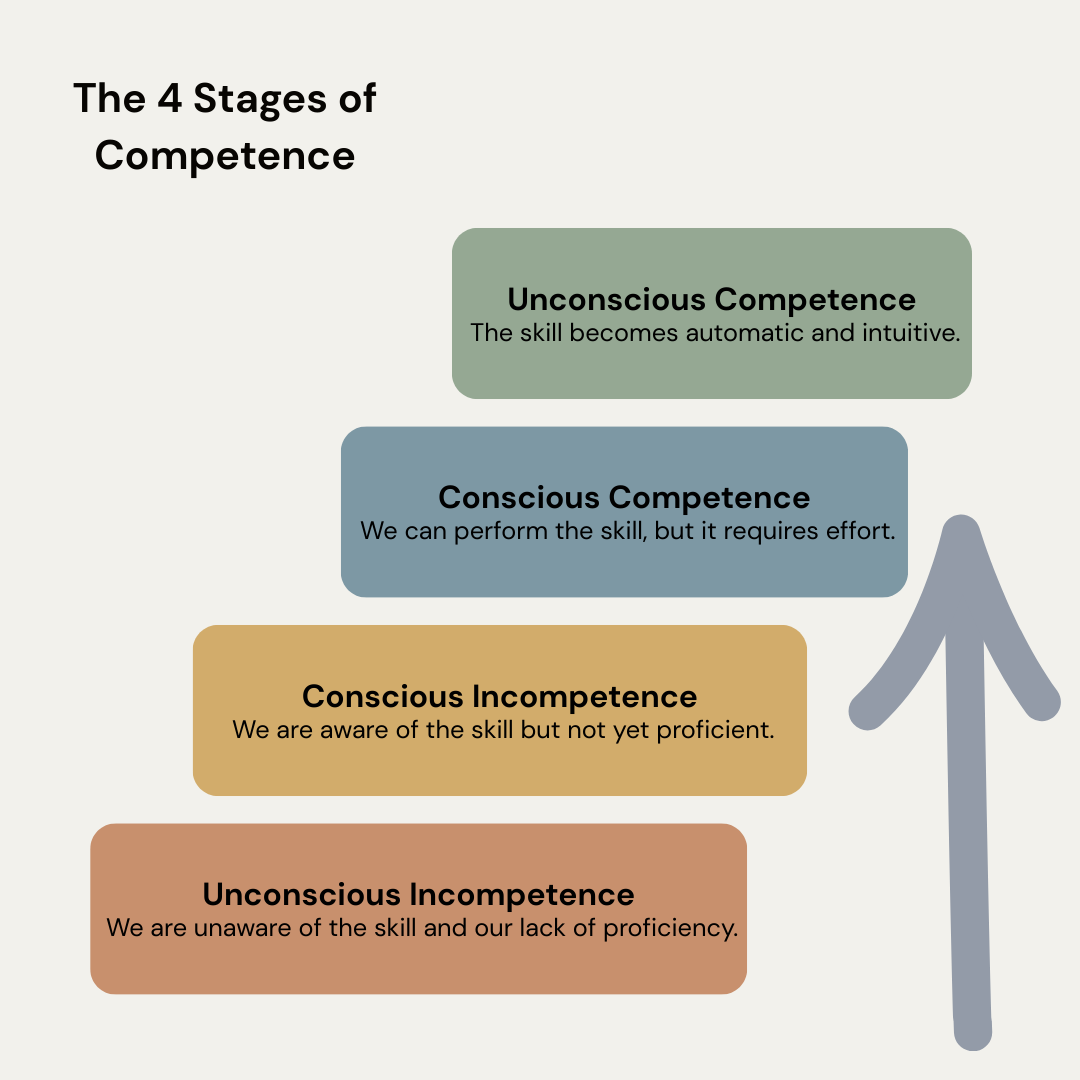
The shift is subtle but profound: we move from being the person with answers to the person asking better questions.
The friction comes when our ego grieves the loss of being the most capable person in the room. We’re trading the safety of reputation for the uncertainty of potential.
2. The Nervous System Recalibration
High achievement often creates a familiar stress-reward loop. We’re used to visible wins, KPIs hit, promotions earned, and recognition received.
In transition, the wins are quieter. They look like reflection, research, conversations, and internal shifts.
The shift is that progress becomes internal before it becomes external.
The friction arises when, without immediate validation, our nervous systems interpret the silence as risk. Anxiety increases but because our old clear metrics we are used to for tracking success no longer apply.
3. The Structural Realignment
A career transition can feel like renovating a house while still living in it.
To build something new, parts of the old structure must come down.
The shift begins when we start questioning long-held “shoulds.”
We should want the title.
We should stay because we’ve invested this long.
We should be grateful.
The friction is the sound of those inherited expectations cracking. It can feel like instability, but it’s often alignment emerging.
We’re not unraveling. We’re updating.
4. The Liminal Space Paradox
There is always a transition point between our past identity and our emerging one.
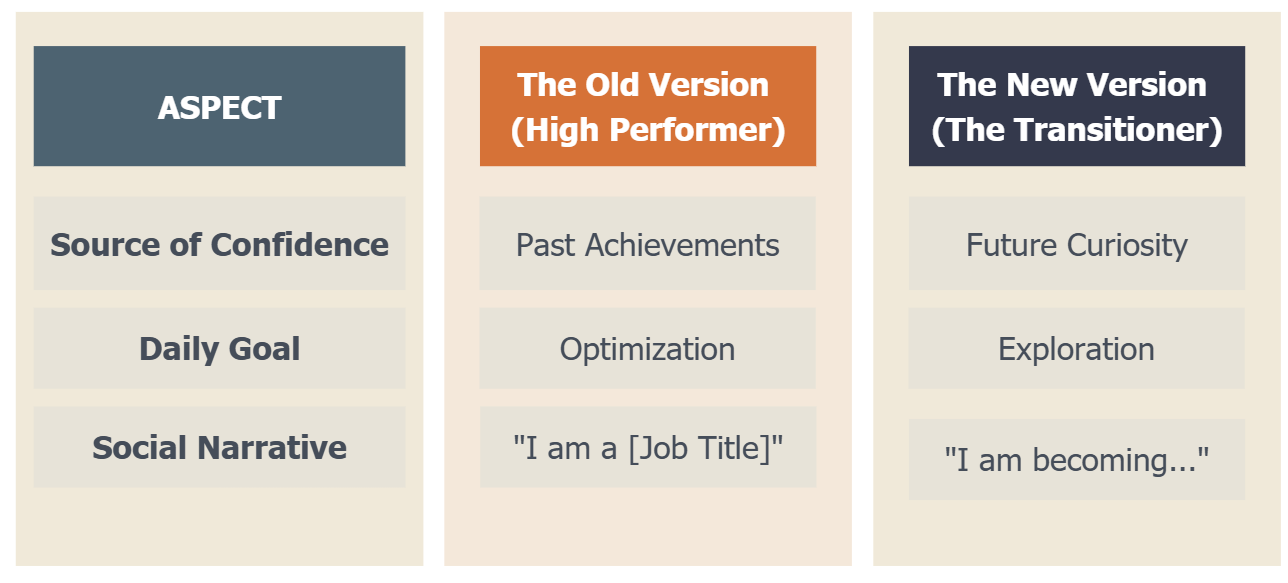
In the previous version of ourselves, confidence came from past achievements. The goal was optimization. Our identity was clear and socially reinforced.
In transition, confidence begins to come from curiosity. The goal shifts toward exploration. The identity moves from “I am…” to “I am becoming…”
We cannot fully step into the next version of ourselves while gripping tightly to the old one.
That unsettled feeling?
It’s the sensation of letting go.
And letting go always feels unstable before it feels expansive.
The Emotional Cost of Doing Everything “Right”
There is an invisible cost to doing everything right.
Many high-performing women followed the responsible path. They chose stability. Stayed loyal. Endured challenges. Adapted. For a long time, that strategy worked.
What once felt motivating can start to feel draining.
Psychological research consistently links chronic misalignment between values and work to burnout, emotional exhaustion, and disengagement. [6]
Yet when nothing looks “wrong” on paper, dissatisfaction feels illegitimate.
So we tell ourselves:
I should be grateful. Other people have it worse. This isn’t a real problem.
We wait for a crisis to justify wanting something different. A layoff. A restructuring. Complete burnout.
But dissatisfaction doesn’t need permission.
This phase isn’t a setback. It’s a recalibration. Let’s approach it deliberately.
Why Career Change Triggers Self-Doubt Even When You’re Capable
Career change doesn’t erase competence, but it can obscure it.
Neuroscience research shows that uncertainty activates the brain’s threat response, increasing anxiety and reducing confidence, even in individuals with high self-efficacy. [7]
When familiar reinforcement disappears, the brain fills the gap with doubt.
You’re not starting from zero. But without immediate signals of competence, it can feel that way.
Understanding this prevents you from interpreting discomfort as evidence that you’re failing or that you’ve misjudged yourself.
How to Navigate Career Transition Discomfort With Clarity
1. Reframe Uncertainty as a Phase, Not a Verdict
Career transitions are liminal spaces, a psychological term for the in-between period where the old identity no longer fits, and the new one hasn’t fully formed yet. [8]
This phase is uncomfortable by nature.
But it’s also where transformation happens.
Instead of asking, “What’s wrong with me? ” Try asking, “What is this transition asking me to release or redefine?”
2. Separate Self-Worth From Role and Title
One of the most powerful steps in a career transition is consciously separating who you are from what you do.
Individuals with more flexible professional identities adapt more successfully to career change. [9]
Your skills, insight, resilience, and pattern recognition travel with you, even when your title doesn’t.
3. Build a Transition Strategy Instead of Forcing Certainty
High performers often want clarity before action.
But in career transitions, clarity is more often the result of action, not the prerequisite. [10]
This is where structured support matters.
A thoughtful transition strategy, one that includes reflection, exploration, and low-risk experimentation, allows movement without panic. Progress without pressure.
Frequently Asked Questions About Career Transitions for High Performers
Why do career transitions feel harder the more successful you are?
It is because success increases identity attachment. The more you’ve invested in a role, the more emotionally complex it is to step away. [4]
Is it normal to feel anxious during a career transition?
Yes. Anxiety is a natural response to uncertainty and identity change. Your brain interprets the unknown as risk, even when growth is happening. You’re not doing it wrong. You’re adjusting. [11]
How long does career transition discomfort last?
There’s no universal timeline, but research suggests most professionals experience several months of adjustment as new identities begin to form. [12,13]
Do I need burnout or a crisis to justify a career change?
No. Waiting for burnout often increases emotional and physical costs. Proactive transitions are associated with better long-term satisfaction.
Why does self-doubt show up even when I know I’m capable?
It is because uncertainty temporarily reduces access to familiar competence cues. This is neurological, not personal. [14]
A Gentle Reminder as You Move Forward
Career transitions aren’t a failure of ambition or resilience. They’re a response to growth.
If this season feels unsettling, it doesn’t mean you’re doing it wrong. It means you’re listening to your values, your energy, and what no longer fits.
You don’t need a crisis to permit yourself to change.
And while the in-between can feel uncomfortable, it’s also where clarity accelerates, confidence recalibrates, and a more sustainable version of success begins.
If you’re navigating a transition and want structured, thoughtful support, Career Transition with Claire offers a path forward that honors both your achievements and your evolving priorities. Schedule your free 30-minute consultation now!