
A Career Coach’s Honest Guide to Finding Your Way Forward
If you’ve been laid off, restructured out of a role you thought was stable, or had a leadership decision pull the rug from under you, the first few days can feel surreal. You go home at 10 a.m. on a Monday, sit on your couch, and the question staring back at you is, “What do I do now?” I’ve been there myself, and in my coaching work with women across tech and leadership, I hear that exact question every week.
The hardest part is that the old definition of success, the one tied to the title, the company, the income, the identity, stops working overnight. Rebuilding what success means to you is real work, and it doesn’t happen in a weekend. But it can be done with intention, and the path through is far less lonely than it feels in those first 72 hours.
This is what I share with my clients when we sit down together for the first time after an unexpected change. If you’re walking through it right now, or coaching yourself through the high-anxiety, high-achieving woman version of the same story, I hope some of this lands.
Why Unexpected Career Change Feels So Different in 2026
A decade ago, layoffs were rare. They signaled a company was in trouble, and they came with empathy, severance conversations, and time to plan. That’s not the world we’re in anymore.
In the first quarter of 2026 alone, the technology sector announced 52,050 job cuts, a 40% jump from the same period in 2025. Across all U.S. industries, employers cut 217,362 roles in Q1, with artificial intelligence cited as the leading reason in March (15,341 cuts, or 25% of the month’s total). Tech alone has shed almost 900,000 jobs since 2020, with no sign of slowing.
What stands out to me, more than the numbers, is the way the layoffs are being conducted. The perceived lack of empathy. The transactional tone. People who gave 10, 15, or 20 years to a company, who were top performers, getting an email at 6 a.m. on a Monday telling them they’re no longer part of the job. Share prices often rise on the announcement. The message that sends to the people on the other end of it is, frankly, brutal.
That’s the backdrop. If you’re feeling shaken, you’re not overreacting. The contract between employee and employer has changed, and most of us never agreed to the new terms.
The First Wave: What You’re Actually Feeling
When I sit with clients in the weeks after they’ve been let go, I see the same mix of feelings come up almost every time. Grief. Loss. Embarrassment. Shame. The thought, “I never thought this would happen to me.” Self-doubt: “Is this a reflection of my work?”
These feelings are normal, and they take time to work through.
There can also be financial pressure on top of the emotional load, especially if you’re the main breadwinner in your household.
That pressure is real, and it can make it tempting to skip past the processing step entirely and start applying to jobs in a panic the next day.
I’ve watched a lot of people try that, and it almost never goes well. Applications sent from a place of panic read as panic. The interviews that follow read as panic. You end up in the wrong room having the wrong conversation.
The first job is to let yourself feel what you’re feeling, while still moving forward in small ways. Tell the people closest to you. Take a few mornings to sit with it. Then begin.
My Own Story: The Dublin Office Closed Leading To Google Opportunity
I’ll share a moment from my own career, because the pattern I’m describing isn’t theoretical for me.
Years ago, I relocated from London to Ireland for a new job. I’d given up my flat, packed my life, and was excited to be back near my family. I’d been in the new role less than two months. One morning I walked into the office and noticed something off. A lot of closed doors. People whispering. Within an hour, my manager called me in and told me the head office had decided to close the entire Dublin office. Everyone was being let go.
I was in shock. It was 8:30 in the morning. I asked, “But I just started here two months ago. How could you not have known this was coming?” The answer was that the financials had hit a bad quarter and the company had made the call. None of us had seen it.
The first few days I was consumed with the same questions everyone is consumed with. How will I tell my friends and family? Does this reflect badly on me? What do I do now?
But then something shifted. The job I’d taken in Ireland was in food manufacturing, and while it was interesting, it wasn’t really the industry I wanted. I’d always wanted to work in tech. Dublin happened to have a thriving tech sector. So I started looking, available at short notice, in the right place at the right time. That’s how I ended up at Google.
I would not have found that role if I hadn’t been let go. I tell that story not to suggest layoffs are secretly a gift (they aren’t), but to make a point that took me years to fully see: being adaptable and staying open to opportunities you didn’t originally plan for is one of the most valuable things you can do during an unexpected transition. The plan you had on Sunday night is not the plan you need on Wednesday afternoon.
If you’re in those first foggy weeks after an unexpected change and want a thinking partner to help you figure out the next step, I’d love to talk.
Identity After a Job Loss: The Hardest Part Nobody Warns You About
When I left Google after almost 12 years, my identity was a huge part of what I was leaving behind. I had grown up there professionally. So much of who I was, how I introduced myself, what gave my days shape, was bound up in that role. Walking away meant figuring out who I was without it.
Greta Petruska, leadership coach, I spoke with described the same thing after she left McKinsey, where she’d spent 13 years. She made the decision herself. She knew the next step was somewhere else. What she wasn’t prepared for, in her words, was “the morning after when nobody calls.” She found herself questioning, “What is the impact I’m creating?” She had built her entire identity around that job, and stepping away from it meant rebuilding from the foundation up. It took her time to go back to her values, her purpose, and figure out what the next chapter looked like.
If you’re noticing that your sense of self feels shaky, that’s okay. That’s a normal reaction to losing something that, whether you realized it or not, was holding a lot of weight in your life.
The good news is that identity is meant to evolve. It evolves whether we want it to or not. As we mature, our value systems shift.
The things that mattered to us in our 20s are not the things that matter in our 40s.
A career transition, even an unwanted one, can be the moment that forces the question, “What do I actually want now?” Many of my clients tell me it’s the first time in years they’ve stopped to ask it.
What Actually Helps in the First 90 Days
Here’s the practical part. When clients come to me in the early stages of an unexpected career change, this is the work we do together.
Process before you pivot. Give yourself a real beat to feel what’s happening. A few days, sometimes a few weeks. Talk to people who care about you. Don’t try to outrun the emotion by sprinting into job applications. The plan you build from a settled place is dramatically better than the plan you build from a panicked one.
Take inventory of what you actually have. I see so many people, including the colleague I mentioned earlier, hit a moment where they think, “I built a career and now I’m at square zero.” It’s not true. You have years of skills, relationships, judgment, and pattern recognition. Even if your next chapter is in a different industry or a different culture entirely, those things are the foundation you’re building from. Going back to your fundamentals (your values, your strengths, what you genuinely care about) often reveals more options than you can see when you’re standing in the middle of the shock.
Reconnect with your network. Yes, even though you hate networking. When you’ve been at one company for a long time, you become a little removed from how the rest of the market works. How other companies hire. What’s actually happening in your industry. Reaching out to people you haven’t spoken to in a while is uncomfortable, but it’s where most of the real opportunities live. Coffee chats, virtual or in person. People in the workforce, people also looking, people who were out of work and got back in. Each one teaches you something about the current landscape.
Be honest about being in transition. A friend of mine who recently moved to California told me the hardest part of networking, in the beginning, was admitting she was new and looking. After 15 years of experience, it felt embarrassing to say, “I need help.” Once she let that wall down and started telling people, “I’m new here, I’m building connections, I’m in the middle of figuring out what’s next,” everything got easier. People want to help. They can’t help you if they don’t know what you’re navigating.
Walking through these steps with someone who’s done it themselves can change how the whole process feels. Let’s see if we’re a fit.
Networking When You’re an Introvert (Like Me)
I want to address this directly because it comes up almost every time I bring up networking with a client. Some version of, “I hate networking. I don’t want to put myself out there. I’m an introvert.”
Same. I can do one or two networking events a week before I’m done. Here’s what works for me, and what I share with clients who are dreading it:
Go to events that have structure. Two unstructured hours of small talk with strangers is a special kind of awful. Two hours that include a 30-minute talk in the middle? Much more bearable. Show up 15 minutes before the talk, do 15 minutes of networking, sit through the talk, and you’ve already met a few people who chose to be in that room because they care about the same things you do. That’s a built-in filter.
Don’t put pressure on yourself to meet 10 people or land a job offer that night. One or two meaningful connections is a successful evening. If you can come home having had a real conversation with someone who shares your industry or interests, you’ve done well.
It’s about depth, not breadth. The curated experience matters more than the volume.
Redefining Success: The Question Underneath the Question
The reason this article is called “Redefining Success” is that I’ve watched the meaning of the word shift, in real time, in the room with my clients. The version of success they had at 28 (climb the ladder, earn more, take the bigger title) is rarely the version that fits at 38 or 48.
The colleague I mentioned, after she left McKinsey, found that flexibility had become one of her highest values, when in the past she’d given it almost no weight. Being able to choose how to spend her time mattered more to her than the title or the prestige. She didn’t realize that until she was outside the structure that had been making the choice for her.
I see this all the time. People come into coaching after a layoff or a burnout episode, and the first thing we have to do is rebuild the definition. Not what their parents told them success was. Not what their LinkedIn feed says success is. What it actually is, for them, at this stage of life. Sometimes that means a different job in the same industry. Sometimes it means a portfolio of work (some contract, some freelance, some part-time), spreading the risk so that no single company holds your future. Sometimes it means starting something of your own.
There’s no one right answer, and the question is the work.
The Shift Toward Portfolio Careers
When I joined the workforce in my 20s, the unspoken contract was: you give your loyalty, the company gives you stability and growth. Most of my clients now don’t trust that contract anymore. They’ve watched it break too many times.
What I see them moving toward is portfolio work. Some contract work. A side project. Some freelancing. A combination that means if one piece of income or one company stops working, the rest holds you up. It’s not for everyone. It requires a different relationship with uncertainty than a single full-time job, and it can challenge your identity in new ways. But for a lot of women I work with, it’s becoming the more honest answer to the question, “How do I want to build my career from here?”
If that’s the direction you’re considering, the same advice applies: don’t copy-paste someone else’s version of a portfolio career into your own life. Reflect on what fits your personality, your financial situation, and what you actually want your days to feel like.
When to Bring in Help
There’s a moment in most career transitions where you realize you can’t see your own situation clearly. You’re too inside it. The voices in your head are loud, the perspective is narrow, and the same three options keep spinning.
That’s the moment to bring in someone outside. A coach, a mentor, a trusted advisor. Someone who can ask the questions you can’t ask yourself and help you spot the options you can’t see from where you’re standing.
This is the work I do every day. If you’re navigating an unexpected career change and you’d like a thinking partner, I offer a complimentary intro call where we can talk through your goals and figure out if coaching is the right fit for you right now.
Ready to Figure Out What’s Next?
If you’re in the middle of an unexpected career change and the path forward feels foggy, you don’t have to figure it out alone. I help women like you redefine success on your own terms and build a next chapter that actually fits.
Book a free discovery call and let’s talk through what you’re navigating.
Your next chapter starts with one conversation. Take the first step today.
Full Transcript of Redefining Success After Unexpected Career Change
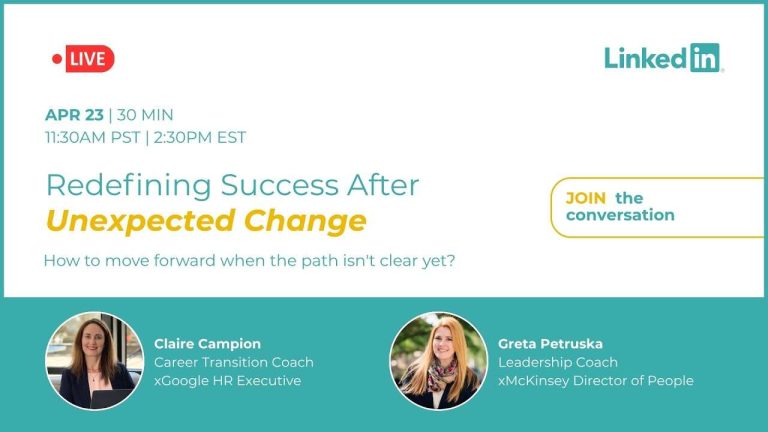
A conversation between Claire Campion and Greta Petrushka
Speakers:
– Claire Campion — Career transition coach; formerly HR executive at Google and Grammarly (~20 years corporate, ~12 years at Google)
– Greta Petrushka — Leadership coach and CEO at HTB Consulting; formerly McKinsey (13 years), then two tech startups; moved from Eastern Europe to California two years ago
CLAIRE: Welcome to our live discussion today on the topic of redefining success after unexpected change. And speaking of unexpected change, Greta and I were due to go live on LinkedIn about 15 minutes ago, but LinkedIn live did not want to play ball with us. And so in real time, we improvised and pivoted, and we are now recording on Zoom. Yay! The conversation will be exactly the same, but we just won’t be live on LinkedIn as promised. We’ll be live on Zoom.
GRETA: Awesome. Thank you, Claire.
CLAIRE: So, currently, a lot of people are dealing with a career change that they didn’t plan for, whether it’s from restructures, layoffs, leadership decisions, or simply realizing the definition of success no longer works for them. Today we wanted to open up a conversation about what these moments really feel like and some ways to be able to navigate through them. But first, some introductions. My name is Claire Campion. I’m a career transition coach, formerly an HR executive at Google and Grammarly. Greta?
GRETA: Hi everyone. My name is Greta Petrushka. Right now, I’m a leadership coach and CEO at HTB Consulting. Before that, I worked for McKinsey for certain years and two tech startups, and I just recently — I mean two years ago — I moved to the US, but it feels like it happened just now. So we are two Europeans living in the US.
CLAIRE: Exactly. So why is this topic important today? Firstly, for me, I would say at the moment, hardly a day goes by when I don’t read in the news about another round of layoffs. These days used to be rare and a sign that potentially a company wasn’t doing well in the past, but now we’re seeing this more and more often, and the message is quite the opposite. Share prices often rise when layoffs are announced. Personally, the part that stands out to me is the way the layoffs are conducted and the perceived lack of empathy in how they’re handled, and how they’re now being seen almost as a transactional process — even if somebody has been there, you know, 10 or 20 years and were a top performer. Greta, can you share a bit more about why this topic is important to you?
GRETA: Yes, you know, it’s just the same as you, like reading the news and also like adjusting to the US processes. It’s quite brutal to see how these layoffs are happening, and I also went through quite a bit of change in the past six years, I would say. Some of them were by choice and some of them not so much. So this topic is top of mind because, as I mentioned, I moved to the US two years ago and I’m still adjusting, and it’s quite a bit of an adjustment. So everybody who is navigating change, I just empathize with those people, and I’m one of those as well.
CLAIRE: Thank you, Greta. So, I would say from what I’ve seen and also actually personally experienced once myself earlier in my career with job losses and unexpected change, is that in the first instance, it is very tough — and especially in the beginning when you get mostly that shock news that you’re being laid off or there’s a team restructuring or something, you know, very fundamental is changing in your work. And oftentimes I think we feel a mix of feelings. It can be anything from grief to loss. And you know, sometimes we feel embarrassed or ashamed. We often may think “I thought it would never happen to me.” We often doubt ourselves and wonder “is it a reflection of my work?” And it does take time to work through these feelings and to process them. And there often can be added financial pressure too if you are the main breadwinner in your household.
I would also say the pace at which many of us are living our lives today is just fast-paced. We live in a very dynamic, fast-moving world, and many of us can default into that lifestyle of living our life on autopilot and moving fast, and then a surprise restructure or a severe episode of burnout comes along and really forces us to pause and to take stock of things. In my coaching work, I often hear people saying, it’s the first time in years that I’m actually thinking, what do I actually want to do now with my career? Because maybe earlier in their career, they stumbled into their career, or they were encouraged to go a certain path that maybe their parents encouraged them or for financial reasons they were told go down this path. Greta, I know identity is a topic close to your heart. How do people think about identity after a job loss, for example?
GRETA: So you know, this is something which can hit really hard. And so for example, when I left my job at McKinsey, it was my decision, and you know, I knew that the next step is maybe somewhere else, but what I didn’t realize is that for so long it was just like a huge part of my identity. So work was extremely important for me, and when I made this decision, what I was not prepared for is the morning after when nobody calls. And actually, okay, I was questioning myself — what is the impact I’m creating? So my identity was really around my job and work at McKinsey. So it took quite a bit of time to understand how to go back to my fundamentals, how to go back to my values, how to go back to my purpose, or maybe even find my purpose for the next chapter. But identity is definitely something which is evolving, and not just because of job loss or the decision to change careers, but actually as we mature in our lives, our value systems are changing and life happens. So the best thing we can do is adapt and go with the flow.
CLAIRE: Yes. And I’ve seen so many people say similar to what you just mentioned — that this wasn’t the plan, but it was the turning point I almost didn’t know I needed. When you speak about identity, do you want to share a bit more about the length of time you were at McKinsey, and do you think because you were there for a number of years, your identity evolved throughout that period of time?
GRETA: Yes, that’s for sure. So I spent 13 years at McKinsey, which is significant, right — not, you know, any company and any profession. And I started there when I was mid-20s, I would say, and my priorities were completely different. I was like super eager, very hungry, you know, I wanted to learn, experience, and just like get everything that came with the job. I was traveling a lot and building my career, and it was a really fantastic time, and I had exposure to many different people and all sorts of tasks and responsibilities. But as I got older and older, something else grew in me, and I guess this is also part of how my identity evolved and how my value systems shifted. So I actually wanted to spend more time at home. I wanted to spend more time with my family. And right now, you know, it’s been six years — six years, five years since I left McKinsey — and I’m in a very different place right now living in California instead of Eastern Europe. There is a cultural shock, and what I also noticed and realized for myself is that flexibility is something which I value extremely right now, which in the past was not really important for me because I was so dedicated to my job that everything else was, you know, put in the second, third, fifth priority. And right now how I can spend my time is extremely important.
CLAIRE: Thank you for sharing all of that. I also had a similar experience, which is how Greta and I met and bonded a number of months ago. For me personally, I had a corporate career for 20 years. A long stint of that, almost 12 years, was with Google, a mix of in Europe and here in California. And I thoroughly enjoyed my job when I started there. You know, it was fast-paced. I was learning a lot. I was in the office for a lot of hours, but it was very motivating, and I was around lots of very smart people, and Google is always working on innovative things. So it’s always interesting. But once I hit like 10, 11 years, I was getting older, my priorities were also changing, and while I looked very successful on paper — good job, good title, earning good money, also traveling the world and got the opportunity to relocate to California — I also realized that I had stopped enjoying the environment, and work actually felt like it was draining my cup more than filling it up. And for me, I had this constant tension for probably 12 to 18 months before I decided, okay, you know, this is the sign, this environment isn’t for me anymore. I also chose to leave, and then a year ago started working for myself and set myself up as a coach. But my identity was a huge part of my working at Google for so long. It was also where I probably grew up through most of my career. And leaving and figuring out my identity after I worked there was also something I definitely grappled with for a few months.
GRETA: Yeah, absolutely. It resonates with me as well. It took me, I would say, two years to make a decision. And probably that was the hardest decision in my life, to be honest. And it took some time to adjust and figure out, like, okay, so how do I create value in this world without this job, without this title, without everything that comes with the job. So when kicking off this topic and this discussion, you were talking about how many different emotions and feelings are coming up when an unexpected change happens. And for both of us, this example is an example for our decision — and we made this change, and still came with so many feelings which we had to deal with. And right now there are so many people who are just given this decision and they cannot control the circumstances. So I’m just wondering — what is your perspective when an unexpected change happened, and you didn’t really expect to get let go on a Monday morning, 6:00 a.m., just getting an email that you are no longer part of the job? So what could help to navigate such a situation?
CLAIRE: Yes, this actually happened to me earlier in my career. I relocated from the UK to Ireland for a job. Gave up my job in London, and I was ready to make the move back to Ireland, and I had literally been in my job less than two months, and I went into the office one morning. There were a lot of closed doors and people whispering, and I thought, something doesn’t feel right. And within an hour, my boss called me into the office and said the head office of the company had decided to completely close down the Dublin office, and everybody was being let go.
GRETA: Wow.
CLAIRE: And of course, I was in shock. It was 8:30 in the morning. I had just gotten into the office. And I also said to my manager, “But I just started here like two months ago. How could you not have known this was coming?” And they said, “We honestly didn’t. Our financials have hit a really bad quarter, and this is what the company have decided.” So yes, in those weeks afterwards, I think first there is the shock of literally just processing what happened, because you go home and it’s 10:00 a.m. and you’re just sitting there going, “What do I do now?” And I think you think of a number of things. You think, okay, how will I tell my friends and family? Does this reflect badly on me? And I think that’s the first few days you’re kind of consumed with that, at least for me personally.
And then it’s like, okay, what am I going to do now? What’s the forward plan? And I think the company I ironically had moved across to Ireland for was an interesting role, but it probably wasn’t in the industry that I would have personally chosen. It was in the food manufacturing industry. And I thought at the time, this job is fine for now and for a few years, and it will get me back to Ireland. But when I realized I had to find a new job, I was like, you know, I always wanted to work in tech. I’m here in Dublin. There are so many tech companies here. And I started looking for a job in tech, and ironically, this is when I started at Google. I probably wouldn’t have found that job if I hadn’t been let go and was available at short notice and in the right place at the right time. And so I think being adaptable — although it’s easy to say being adaptable — just being open to new opportunities, even if they weren’t originally what you thought might come up. And comfort in knowing that it’s less about you, even though our mind often wants to go there, and not letting it affect our self-esteem and our self-confidence too much. And then after we’ve had that healing time, I think it is very much about figuring out, okay, what’s the ideal role, the ideal environment, the ideal type of work I want to be doing, and kind of almost pivoting in that direction and going after it and seeing what opportunities come up.
GRETA: And thank you for sharing. This is such an amazing example, and you know, there was so much wisdom in what you were saying. And what sits with me quite a bit is, like, how to see opportunity in a situation which doesn’t seem like an opportunity at first. So I agree with you that processing is an extremely important part, and asking help from others during those times — that’s definitely something which I would also highlight. But probably the hardest part is how to shift perspective and, you know, in a given situation just like see the positive and try to leverage it to your advantage and really just like look around. Okay, I have this skill set and experience, no matter how little, you know, or how long, and take it as a stepping stone and as a foundation. And don’t think like, okay, now I need to start from scratch. I built a career and now I’m at square zero. It’s not true. So you have so much knowledge and experience on which you can build the next chapter, and the next chapter might be in a completely different industry, environment, or culture. But going back to the fundamentals and your values, your strengths could actually help you see much more opportunities than what presents itself at first.
CLAIRE: I totally agree, and I think, you know, when I joined the workforce in my 20s and into my 30s, the kind of psychological contract with the company was: you work hard, you dedicate yourself to the company, and ultimately they will look after you, you’ll be well paid, have interesting work, etc. That’s at least my experience in the tech industry, which is most of my experience. And then over time in the most recent years, I think that psychological contract has changed, and it’s much more shifting to the US system of employment at will. And while historically if you had one good job that was great, but now I think people are shifting away from — do you know the expression “putting all their eggs in one basket”? — and people are starting to look at portfolio work is one way of calling it, or gig work. So maybe doing something on the side yourself, maybe doing some contract work, maybe freelancing, or a combination of some of those. And I think that spreads out the risk going forward, that even if one thing is not going well, then maybe another part is. And I see a lot of people are moving in this direction going forward.
GRETA: Yes, absolutely. And this is something which is fascinating to me in California. So I met so many people who are just like doing multiple things at the same time, and it’s extremely inspiring. But again, I want to emphasize the identity part, because it’s again an adjustment. So for me, having the corporate background and working for tech startups, and now I consider myself an entrepreneur — so what does it even mean? What is the definition? And you know, what does success mean for me right now? And obviously going after clients and working on different projects, it’s a completely different way of life, and it’s not for everybody. So I would say that it’s a great option to have multiple streams of income. But first, I would definitely recommend to reflect if this is for you, if this is matching your personality or not. And you know, maybe I couldn’t have been an entrepreneur like 20 years ago or 15 years ago or 10 years ago, but in my current environment and my current life situation, this is something which I enjoy and I see a lot of opportunities in there. But again, reflecting on what’s important to you specifically and tailoring your solution to yourself — that’s extremely important. So I don’t think that when unexpected change happens, like copy-paste solutions can work. So this is the time when asking for help could be extremely valuable. So asking help from your mentors, asking maybe are there people who can advise you, going to a coach of course — but just don’t sit by yourself and try to figure out on your own, because there might be a perspective you are just not seeing, and bringing that richness into your thought process could actually expand your choices for the next step very differently.
CLAIRE: And I would actually double down on one of the things you said there about asking for help. I actually would say it’s a must to lean into your network, to reconnect with people that maybe you haven’t spoken to for a long time, to do virtual coffee chats, real-life coffee chats, depending on where you’re going, and just learning about maybe how the market works, especially if you’ve been in one company for maybe several years. My learning was, when you’re in one company for a number of years, you’re a bit removed from the marketplace, what’s happening, how other companies are hiring, and the reality of being close to looking for a job. And so things change, and I would say when you’re back on the job market, definitely reconnect with people across all spectrums. People who are in the workforce, people who are also looking, or maybe people who were out of work for some time and have gotten into a job, and maybe they have some insights they could share. Because as I mentioned, things are changing all the time, and especially with AI, the way companies are hiring. Some companies are even using AI now to do a first round interview, which was a crazy thought 15 years ago when we thought that might actually happen.
GRETA: Yes, absolutely. And again, emphasizing the message on networking and gathering information — and this hits home for me quite a bit, because when I moved to California, I really didn’t have a network here. I didn’t know many people, and the people whom I knew didn’t have connections in California. So the ones who were willing to make introductions actually couldn’t. So I found myself in a situation where I realized I just really need to put myself out there. And the first step was, like, figure out what “out there” means for me. And I started to go to different networking events, women’s circles, and co-working spaces. I went to a certain talk series when topics were resonating with me, because that’s already a filter. So the people who go there are probably in the same field or share the same values that you are. So I started to do that quite aggressively, and at some point I said, like, okay, I’m burnt out of networking because I was doing it so much. But I had to realize that if I don’t show up, nobody will knock on my door and offer me anything basically.
And it’s important for the story that I was applying to jobs like crazy. So I think it’s a full-time job, and I was doing everything I could, and I was very disappointed because the results didn’t come as I expected them to come. So I had to find other ways and alternative solutions. So I just, you know, pushed it as much as I could, and eventually I landed myself a job. And I found out that coaching is something which is close to my heart, and I always wanted to support people, and I always did that throughout my job. So it was kind of like an evolution. But for sure I had to persevere, and I had to show a lot of resilience throughout this period.
CLAIRE: That’s what I was going to ask you — to use your own words, you were “job hunting like crazy” and you weren’t being that successful at the time. Looking back now, what would you say are some of the ways or some of the things that helped you keep your motivation up or helped you just keep going?
GRETA: You know, it’s a family thing. It’s in my DNA to never give up. That’s something which is just, you know, tattooed to my heart or into my heart. But honestly, I always tell myself that, you know, I’m capable. I have a lot of experience and I have a lot of value to offer. So for me, accepting failure in this way was not an option, and it was very hard. So there were days like, I just cannot sit again in front of LinkedIn and, you know, research companies and adjusting my resume and pushing — but you know, that’s what it takes. You have to; you have no choice. And I think that the job market is very tough in the US. I didn’t think that it’s going to be this tough, but it is. So yes, you have to push it. There is no other option.
CLAIRE: Especially I would add — especially so for someone like me who didn’t have a network. So if you, you know, if you went to school in the US, and if you already have work experience in the US, I’m not saying it’s easy. Maybe it’s slightly easier. And if that’s the case, I would just emphasize the power of leveraging your network. That’s, I think, that’s key. And I know for a lot of people, when we say the word networking, people have a visceral reaction. They’re like, “Oh, I hate networking. I don’t like going. I don’t like putting myself out there.” And I would say I would describe myself as an introvert. So I too can only do a maximum of one to two networking events in a week, and I am forcing myself. But what I found workable was, if I go to events where the schedule is quite structured. So let’s say there’s a talk in the middle, and it’s not just two hours of trying to make conversation with people that you don’t know, which can feel very, very long for anyone who finds that difficult or a little bit daunting. So I find, yes, if I go 15 minutes before the talk starts, do 15 minutes of networking, join the talk — and I think to your point, you usually meet people there who are interested in the same, whether it’s industry or specialism, etc. And then I think it’s not putting so much pressure on yourself that you have to meet 10 people or you have to find a job tonight. I think it’s making one or two meaningful connections.
GRETA: Yes, and then that’s a good night of networking and being comfortable with that.
CLAIRE: Yes, absolutely.
GRETA: I 100% agree with you that it’s more about depth and the curated experience. So I’m very similar to you. So there were some situations when I’m like, I just cannot go to another networking event. So you have to understand your own boundaries, and you know, energy level, which you were also talking about. And really finding the people who you genuinely connect with. And for me, it’s also hard to go to these events and within just like no time, you know — what is your title, what you are building, what you are good at, what is your value proposition? And it’s also again, it’s a question of personality. So some folks are extremely good at that, and they have this perfect sentence about themselves. I was not one of those. So I’m still adjusting — how am I introducing myself? But finding your circle, your people, it’s very critical and helpful, because then it’s going to give you also confidence.
And maybe one more thing I would say — for me, it was very hard at the beginning to say that I’m new to this. I’m new to this country. I’m new to this state, and I’m, you know, after 15-plus years of experience, I’m again looking for a job. So it was maybe even embarrassing, and so I had to overcome this mindset and say, like, okay, you know, they might be in the same situation, or they have been in this situation. So why do I think that I’m special and alone in this situation? So I started to actually embrace the fact that I’m new to this state and this city, and actually started to open up about, like, yes I’m new, I’m looking for new connections, and I need help. And it became much, much easier than it was before. So as always, it’s about the mindset and how you want to look at it. So the situation is always as is, right? So it depends on what is your perspective. You can see it as a problem or you can find opportunities in there, and that’s a game changer.
CLAIRE: Yes, I would totally agree with you. And I think hopefully your recent experience of having gone through all of this will be useful for our viewers and people watching this video today.
GRETA: Yes, I hope so too.
CLAIRE: So, in closing, I would say — I know we’ve been talking maybe for 30 or 35 minutes, I wasn’t actually keeping track — but I would say to those of you watching, if you’re in the middle of an unexpected change, firstly, I think we empathize, and hopefully that comes across today. And I would say that at a big-picture level, at least in the world, the way of working is dramatically changing. And so it’s not about you, your performance, your skills. And um, I appreciate that sometimes, where our minds can go and try and tell us that that was the reason. And I also think, as we mentioned, the days of working hard for one company and almost selling your soul are gone. And sadly, now there’s just a lot to process and get used to. If you’ve been let go and you find yourself on the job market, or at least figuring out what’s your next step, what’s your next direction — we talked about adaptability and resilience, and I do think those two things come up to the surface during those times. And I think leaning on friends, family, networks as well. Greta, would you have any closing words today?
GRETA: Yes, just one. Actually, you summarized it extremely nicely. I guess for me the last point would be to connect to yourself. So give yourself time and also grace. And we didn’t really talk about purpose and what really motivates you, but during this time, it’s definitely an opportunity to turn inwards and just take stock of, like, okay, so what I want to do, and what is this situation helping me to see? And going back to your values and your purpose is always a good start, and you can take it from there anytime change hits you.
CLAIRE: Thank you, Greta. So, if today’s conversation has surfaced questions for anybody watching today, feel free to reach out to Greta or me. We’re always happy to help people think through their next step or just have an informal conversation. So, thank you very much.
GRETA: Thank you, guys. Thank you, Claire.